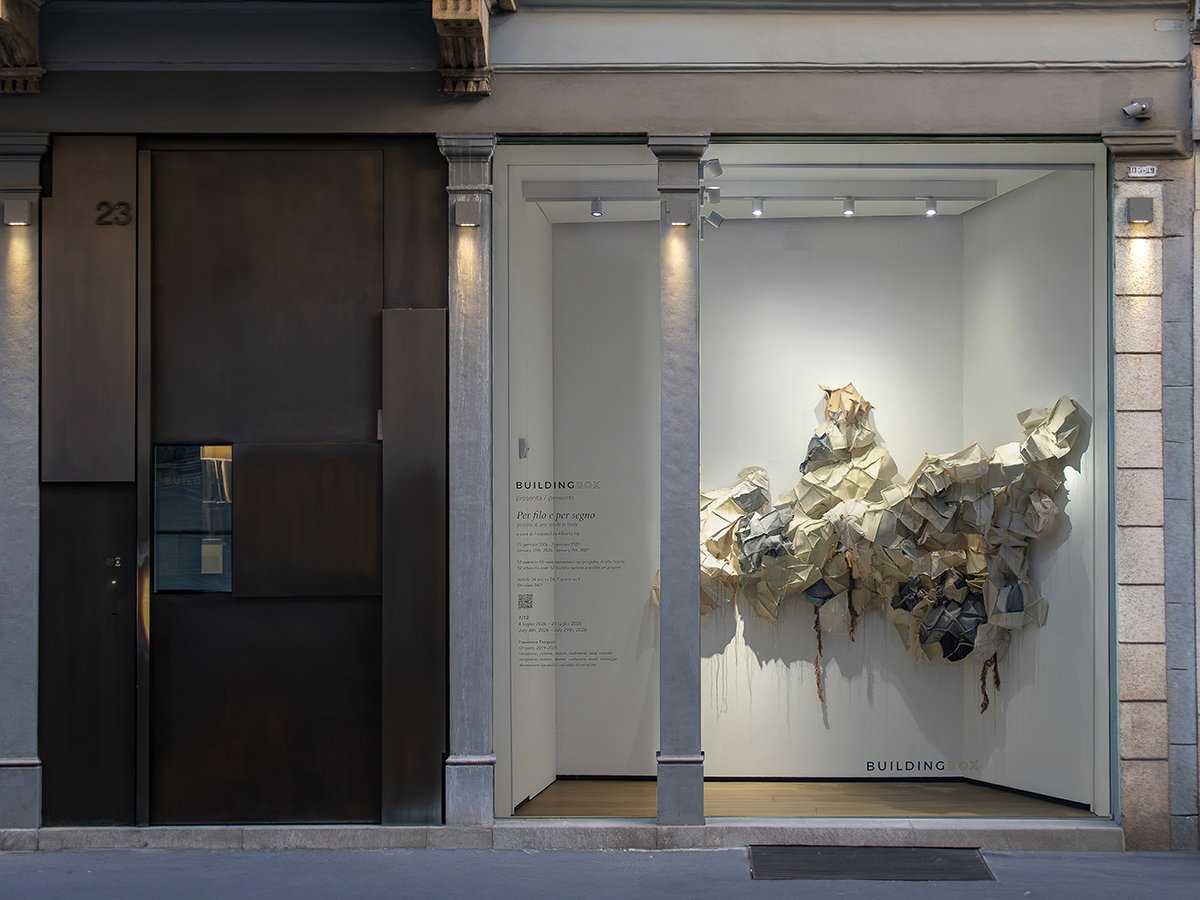

Per filo e per segno – 7/12. Francesca Pasquali
04.07.2026 – 29.07.2026
Francesca Pasquali
Origami
2019-2026
neoprene, cotton, denim, cashmere, wool, selvages
site-specific
variable dimensions
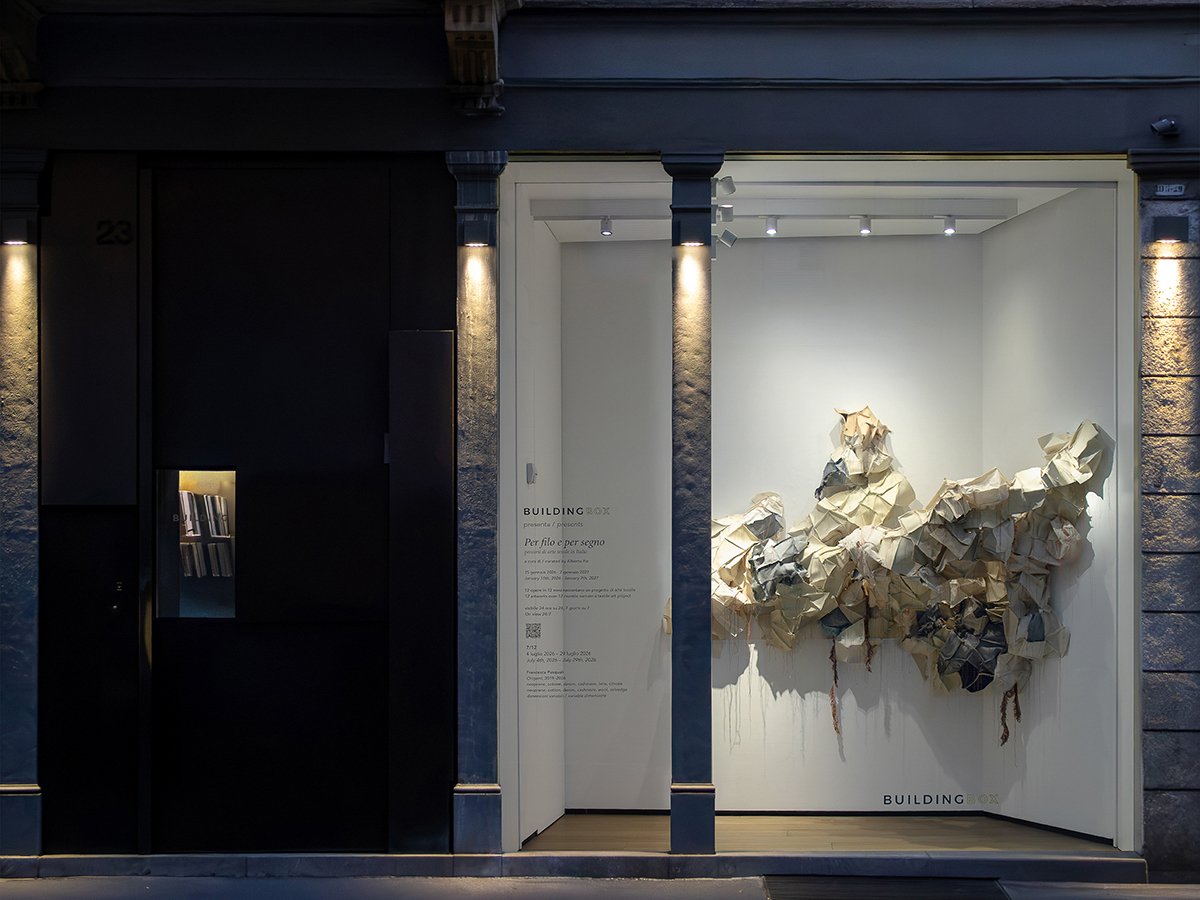
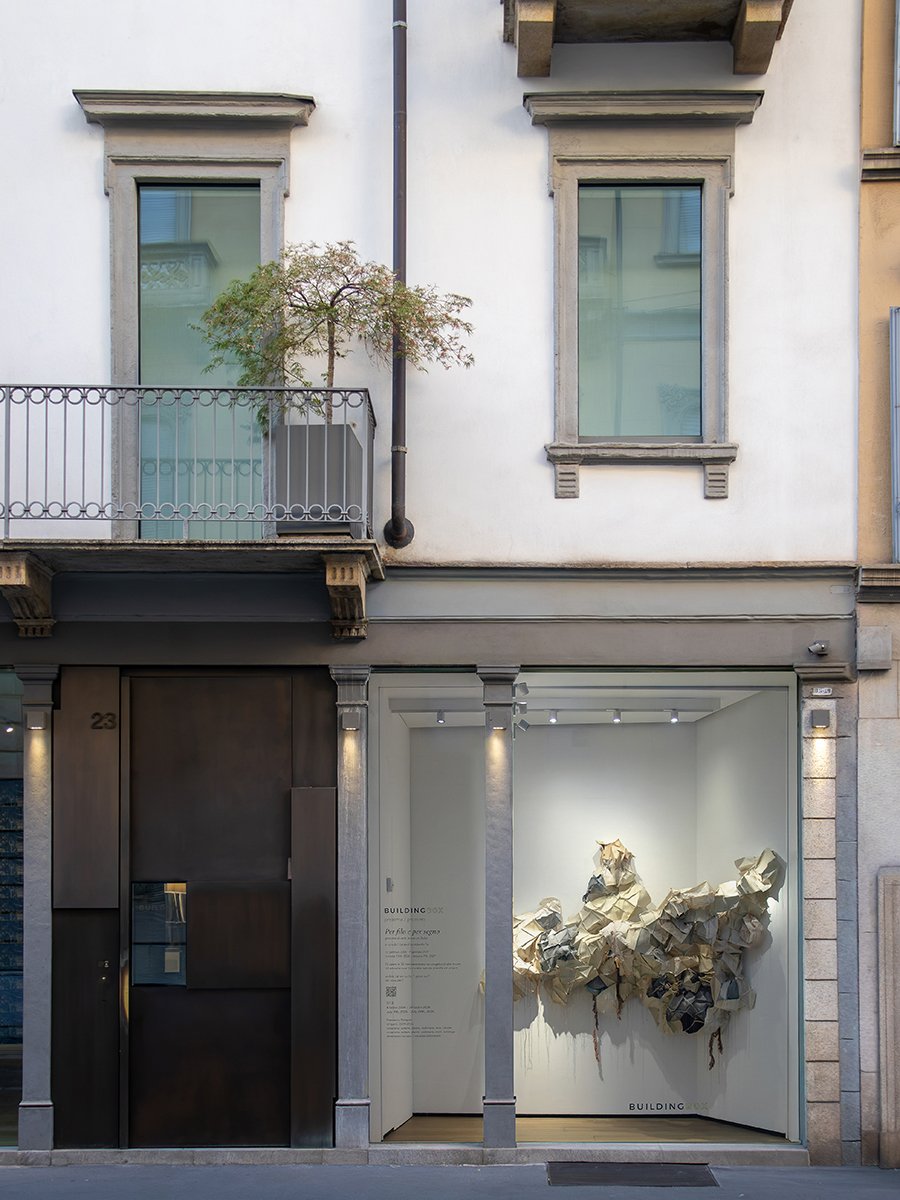
From July 4th to the 29th, 2026, BUILDING BOX presents the seventh installment of the exhibition project Per filo e per segno. Percorsi di arte tessile in Italia with the environmental installation Origami (2019–2026) by Francesca Pasquali (Bologna, 1980).
Origami is a project that began in 2019 and has been completely reworked by the artist for the BUILDING BOX exhibition space, transforming it into a site-specific installation.
The title refers to the ancient Japanese art of creating three-dimensional figures by folding paper, without the use of scissors or glue. In this case, origami serves as an opportunity to reflect on the concept of the transformation of matter and its ability to reconfigure itself.
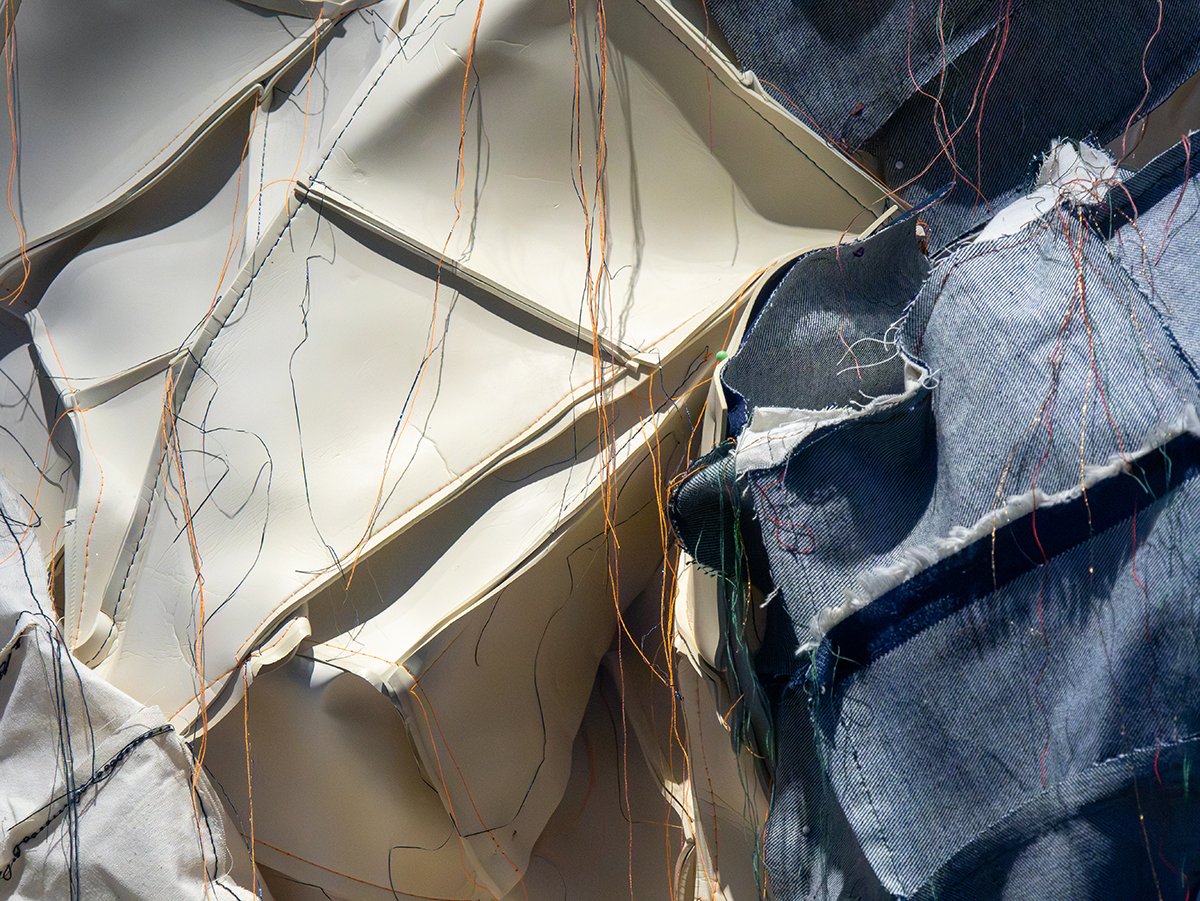
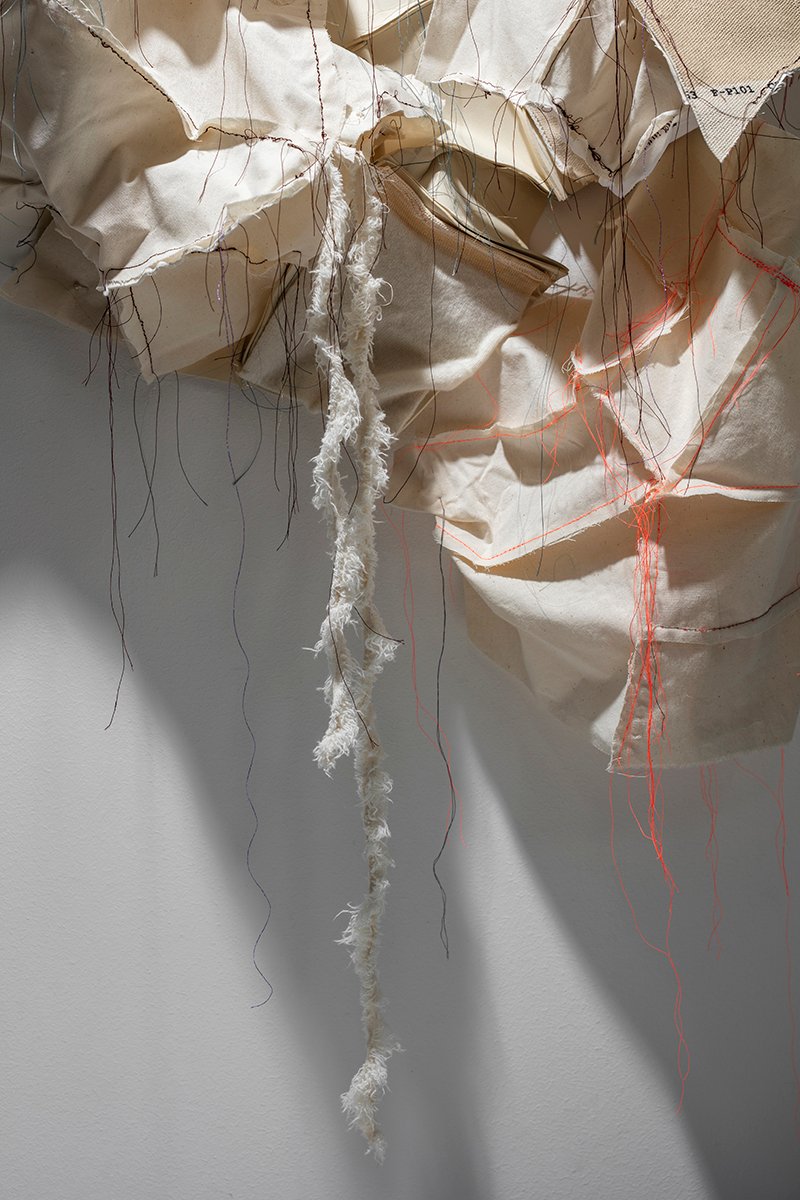
The work on display is created from scraps of neoprene, cotton, denim, cashmere, wool, and selvages—all sourced from various production processes—which have been sewn together to form a vibrant, ever-changing organism. These disparate materials, destined for disposal, thus acquire a new aesthetic identity.
The surfaces appear as membranes that ripple, fold, and aggregate, generating a structure that may evoke a coral formation, a limestone concretion, a biological landscape viewed under a microscope, or even a continuously expanding cellular proliferation.
Nothing is predetermined in a project that unfolds based on the suggestions offered by the materials themselves. As the artist states, “The scraps are machine-sewn with colored threads and white cotton selvages that I have deliberately left hanging, clearly visible so that even a breath of air is enough to create an unexpected shift.”
Origami thus retains an entropic component through a series of misaligned elements that develop an autonomy of their own, free from rationalist logic. Pasquali encourages these digressions by allowing herself to be guided by the unexpected geometries suggested by the context and by constructing a constantly shifting balance traversed by folds, ripples, twists, and movements. What emerges, therefore, is a continuous dialectic between constructive order and organic growth, between the precision of craftsmanship and the unpredictability of becoming.
The work highlights the role of craftsmanship, transforming the practice of sewing into a generative process. The reuse of waste takes on not only ecological but also poetic significance: what might have appeared marginal or residual becomes a foundational element of a new form of beauty. At the same time, Origami creates a constant interplay between industrial elements and natural fibers, giving rise to a permanent metamorphosis that elicits a continuous shift in the viewer’s perception.
___________
From January 15th 2026 to January 7th, 2027, BUILDING BOX presents Per filo e per segno. Percorsi di arte tessile in Italia, an exhibition project curated by Alberto Fiz involving twelve Italian artists from different generations, invited to reflect on the theme of contemporary textiles. Throughout 2026, the exhibition will offer a selection of tapestries, clothing, installations, sculptures and site-specific works in twelve individual monthly installations. The artists featured in the third quarter are Francesca Pasquali (Bologna, 1980), Franca Sonnino (Rome, 1932), Sissi (Bologna, 1977).
The last decade has been characterised by an increasing focus on textile art, which has established itself as one of the most vital languages of contemporary art. The reasons for this can be found, first and foremost, in its ability to restore a central role to the matter and the body in an era dominated by digital technology. Although the use of textiles is nothing new – just think of the fabrics of Fortunato Depero (1892-1960), the carpets of Giacomo Balla (1871-1958) or the tapestries of Alighiero Boetti (1940-1994) what has emerged is an unbiased, often provocative and transgressive process that has involved contemporary artists and, at the same time, has made it possible to highlight some central figures in art history, especially women, who have long been marginalised.
Furthermore, the uniqueness of textiles lies in how they have given rise to an autonomous language, with its own expressive matrix understood as a critical device capable of questioning all forms of hierarchy, according to a renewed awareness that can be traced back to the 2017 Venice Biennale, Viva Arte Viva, curated by Christine Macel, who had built her reflection starting precisely from textile art.
The exhibition project presented by BUILDING BOX aims to connect Italian artists from different generations by developing a fluid, all-encompassing journey that highlights the potential of a versatile, malleable and environmentally sustainable material, where tradition, memory and modernity intersect without rigid formalisation. At the same time, fibers, textures, knots and weaves become relational tools capable of redefining space and the relationship between individuals.
Per filo e per segno aims to make an innovative contribution to the debate on textile art, which on this occasion develops around different perspectives, offering a broader vision with the inclusion of a variety of works such as tapestries, clothing, installations, sculptures and site-specific works, many of which are new projects created specifically for this occasion, confirming how fabric is not only a technique but also an innovative approach to reality and image. Beyond the poetic and stylistic prerogatives, there is a unifying feature that can be traced throughout the exhibition, namely the intimate, in some ways autobiographical, aspect of the research, which is not without attention to the manual component, radically opposing the standardisation and dematerialisation of contemporary society. Per filo e per segno therefore aims to be a meticulous and detailed journey that contemplates the minimal unity of the textiles and the pattern that emerges when the threads are woven together. All this with the aim of generating a new plot through twelve chapters. The artists hosted during the first two quarters of the exhibition project were Numero Cromatico (an artistic collective founded in Rome in 2011), Paola Anziché (Milan, 1975), and Maurizio Donzelli (Brescia, 1958), Antonio Marras (Alghero, 1961), Maria Lai (1919-2013), Paola Pezzi (Brescia, 1963).
Artisti