



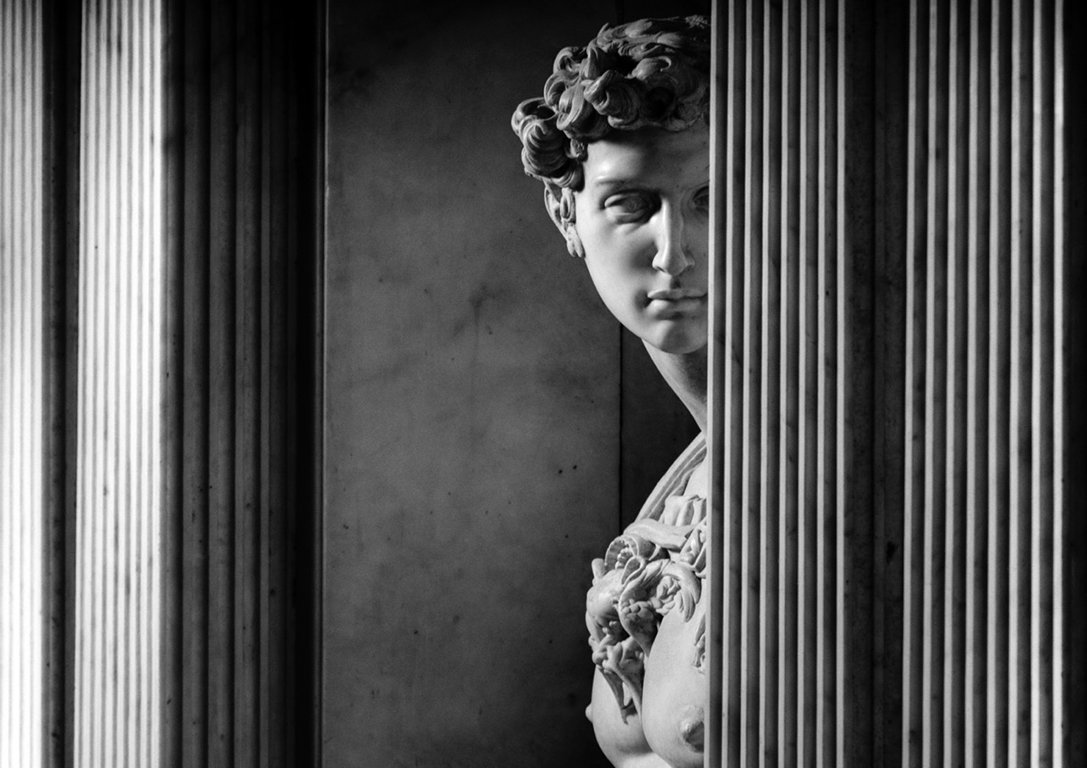
Aurelio Amendola. Capolavori fotografati – Palazzo Reale, Milano
16.06.2026 – 06.09.2026
Aurelio Amendola exhibits again at Palazzo Reale in Milan thirty years after his solo exhibition Cappelle Medicee (1995): from June 16th to September 6th, 2026, the rooms of the palace will host the exhibition Aurelio Amendola. Capolavori fotografati. Burri, Vedova, Nitsch, Duomo di Milano, Bernini, Canova, Michelangelo, an exhibition promoted by the Municipality of Milan – Culture, produced by Palazzo Reale, in collaboration with the Associazione Culturale BUILDING. Through 85 large-format photographs, taken between 1976 and 2025, the exhibition celebrates the most emblematic aspects of the work of Amendola (Pistoia, 1938), a central figure in the field of contemporary art photography, who stands out for his ability to navigate art history and transform light into narrative with a sensitive and intense gaze.
At the heart of the exhibition is the dialogue that the photographer has managed to establish, through his camera’s lens, with some of the greatest figures in the history of art. From the immortal sculptures of Michelangelo Buonarroti (1475–1564), Gian Lorenzo Bernini (1598–1680), and Antonio Canova (1757–1822), to the expressive power of the contemporaneity—represented by Alberto Burri (1915–1995), Emilio Vedova (1919–2006), and Hermann Nitsch (1938–2022)—his images reveal as much the secret life of the artworks as the artists’ deepest identities. This exploration is accompanied by a section dedicated to the Duomo di Milano, featuring a series of previously unpublished photographs that examine the cathedral as a plastic body and sculpted matter: not merely architecture, but a true sculpture traversed by light and time.
Presenting itself as a journey that connects different artistic practices and historical periods, Aurelio Amendola. Capolavori fotografati constructs a powerful and layered visual narrative that reinterprets art history from an intimate and personal perspective, questioning matter, gesture, and memory.
The exhibition opens with an initial group of 41 photographs—brought together here also thanks to loans from prestigious Italian and international collections, such as the Fondazione Palazzo Albizzini Collezione Burri in Città di Castello, the Fondazione Emilio e Annabianca Vedova in Venice, and the Nitsch Foundation in Vienna—dedicated to three major figures of the late 20th century whose artistic practice is deeply rooted in action: Hermann Nitsch, Alberto Burri, and Emilio Vedova. In their works, the gesture becomes a sign, matter, energy, and then a work of art: a visible trace of the creative act. Amendola portrays them in their respective studios, capturing their most intimate and, at the same time, dynamic dimension, conveying the power and intensity of their art through the images.
Among the artworks presented, a selection of photographs illustrates the “blood-red actions” performed by Hermann Nitsch at Prinzendorf Castle in 2012, condensing the essence of his practice into a more intimate and previously unseen narrative compared to the performative and choral dimension that characterizes his actions.
Of particular importance are Alberto Burri’s famous Combustioni: in 1976, in Città di Castello, Amendola created a photographic sequence in which the artist is captured in the act of burning a plastic surface, altering the material. In these images, a creative process emerges clearly, in which the gesture—both mechanical and spontaneous—gives form to some of his most iconic works.
In the 1987 photographs dedicated to Emilio Vedova, instead, the generative vortex of his art emerges. The energy that runs through the works—particularly the large circular paintings—manifests itself as a direct extension of tense, nervous, yet controlled gestures: Vedova is captured as he moves through the space of the studio as if it were a battlefield, and his body becomes the matrix of the pictorial sign.
The exhibition continues with a room entirely dedicated to 9 photographs of the Duomo di Milano (2009), shown to the public for the first time. Through details, perspectives, and the play of light, the cathedral is reinterpreted in all its formal complexity and expressive power. In the context of Palazzo Reale and its physical proximity to the Duomo, the presence of these photographs takes on a particularly evocative significance, reinforcing the dialogue between image and place, representation and presence.
The exhibition concludes with 35 photographs depicting some of the most famous sculptural masterpieces by great Italian masters of the past: Gian Lorenzo Bernini, Antonio Canova, and Michelangelo Buonarroti.
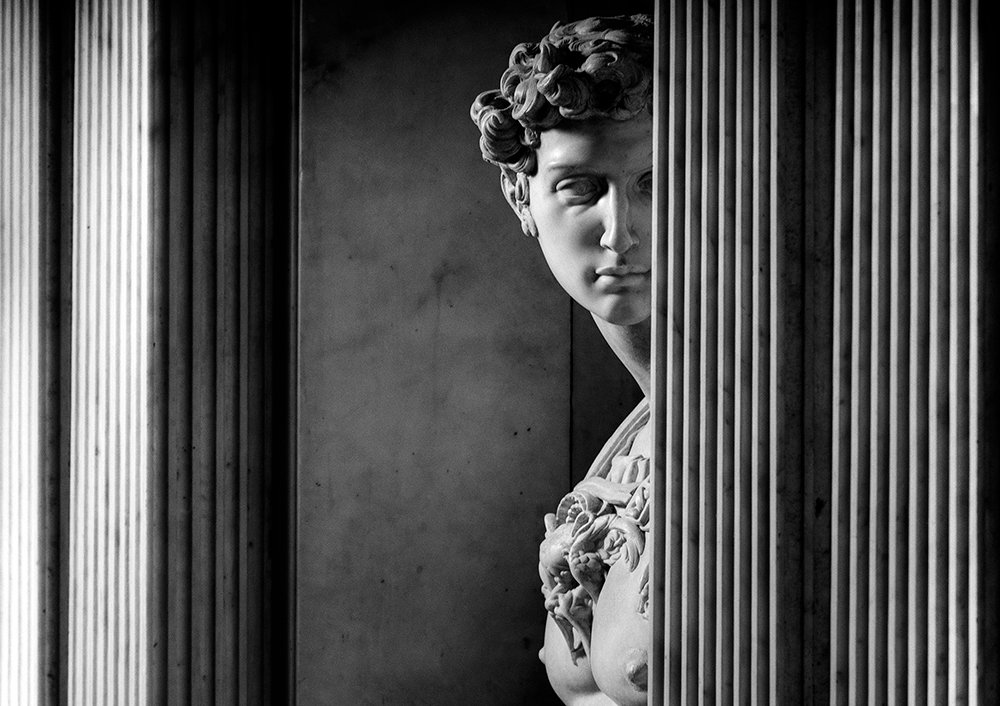
Through elegant plays of light that emphasise the marble surface, Amendola’s black-and-white photographs highlight perspectives and details, offering fresh perspectives on the various sculptural groups: from the drama of Bernini’s Ratto di Proserpina (1621–1622) by Bernini, to the tenderness of time suspended in the embrace between Amore e Psiche (1787–1793) by Canova, to the profound gaze of the statue of Giuliano de’ Medici, created by Michelangelofor the Cappelle Medicee of the Sagrestia Nuova in Florence (1521–1534). The marble preserves the traces of the sculptor’s intervention, revealing itself as a living, vibrant substance. The surface, animated by the play of light and chiaroscuro, is further reinterpreted by the photographer’s gaze, which brings out a new intensity.
A bilingual (Italian and English) catalog published by Skira will be released in conjunction with the exhibition, presenting Aurelio Amendola’s work through a selection of the pieces on display at Palazzo Reale.
Mostre
Artisti
