




Per filo e per segno – 5/12. Maria Lai
08.05.2026 – 04.06.2026
Maria Lai
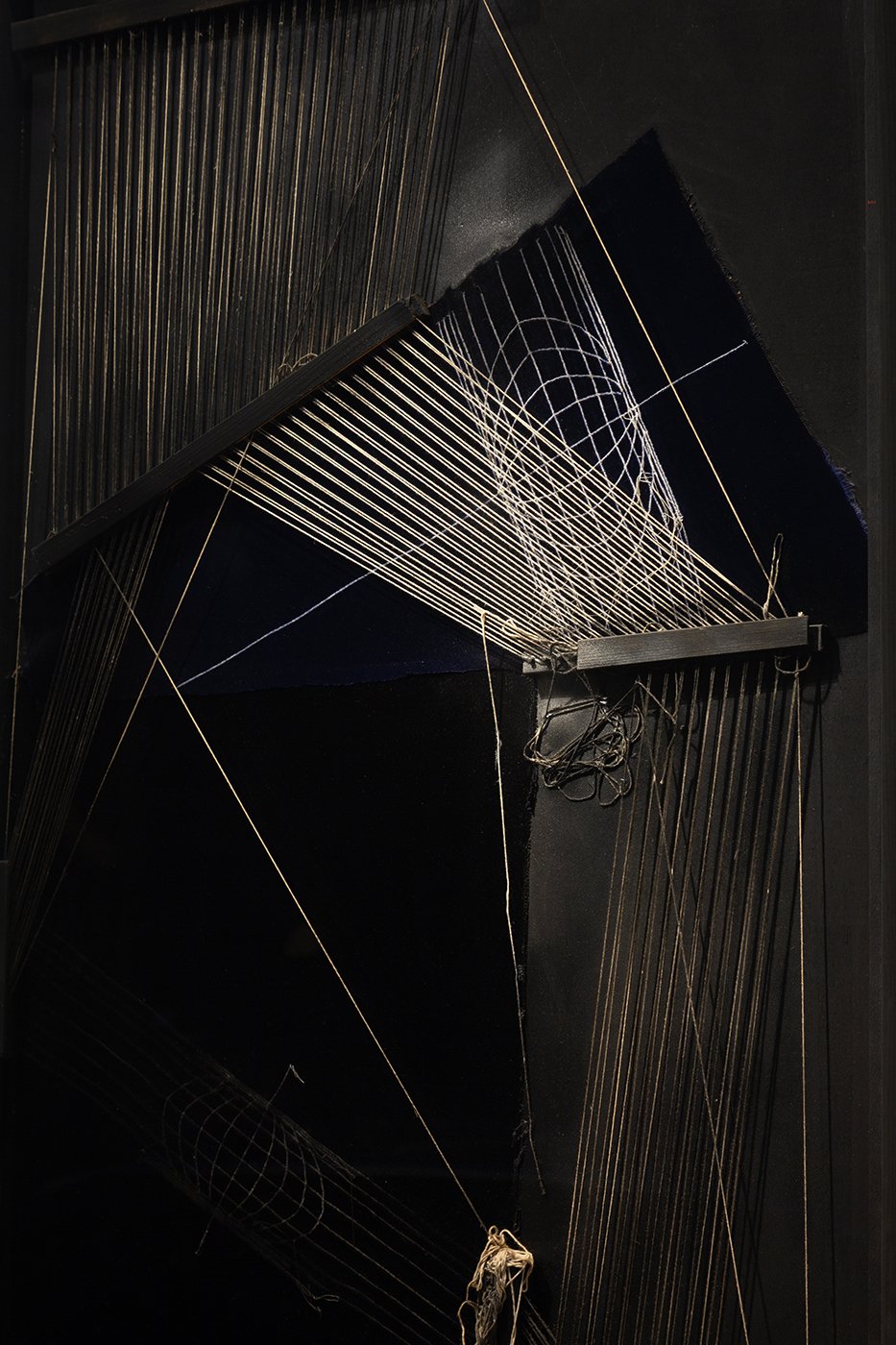
Telaio
2006
wood, thread, fabric
134 x 74 x 4 cm
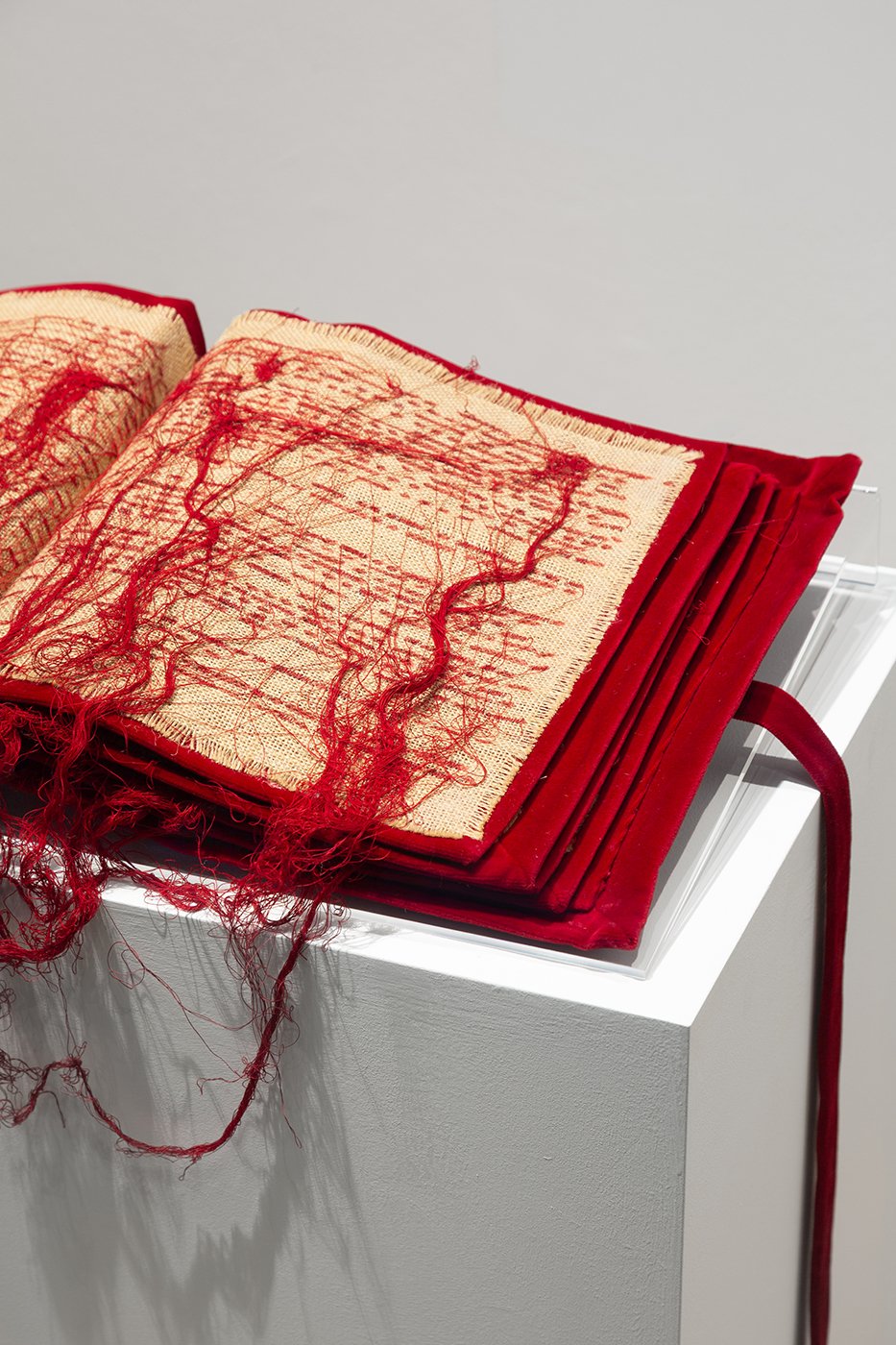
Libro rosso
2009
thread on fabric, velvet
36 x 72 cm
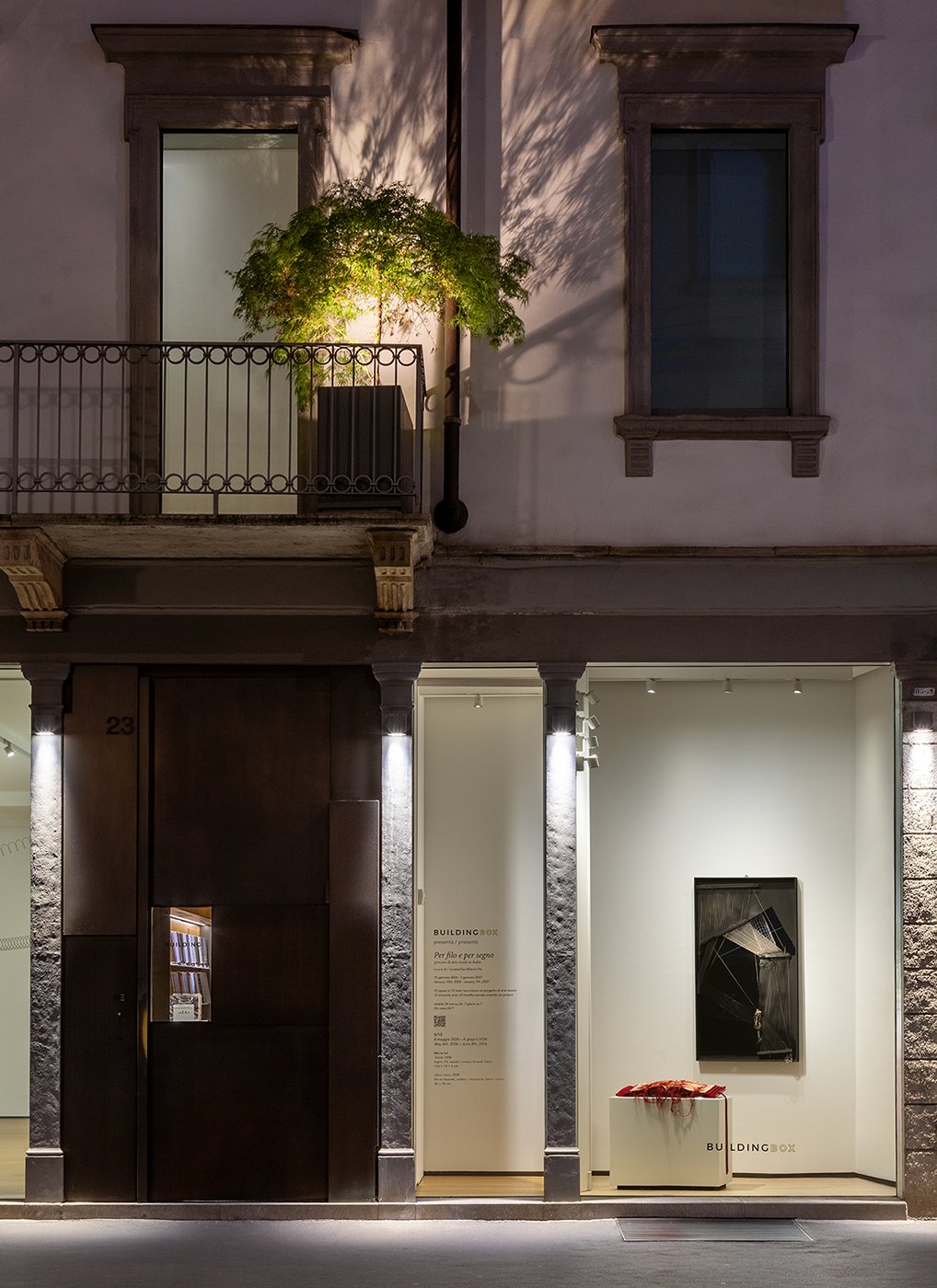
From May 8th to June 4th, 2026, BUILDING BOX presents the fifth installation of the exhibition project Per filo e per segno. Percorsi di arte tessile in Italia dedicated to Maria Lai (1919–2013). The artist is featured with two emblematic works of her research: Telaio (2006) and Libro rosso (2009), intended as complementary testimonies of a poetic universe of great expressive power.
On the one hand, the processual logic of the work Telaio manifests itself in the creation of a magical machine, traversed by threads destined to create unstable geometries through the use of diagonal lines, parallel bundles, or intersections; on the other hand, the work Libro rosso reveals a mental script hidden within silent pages, crossed by tangled and suspended threads.
“To be is to weave” emphasizes Maria Lai, in accordance with the fundamental principle underlying all her artistic practice. The loom, that age-old instrument of weaving, appears as early as a drawing the artist created in the 1940s, and, beginning in the second half of the 1960s, it became a constantly evolving sculptural exercise that continually incorporates different elements drawn from the landscape as well as from painting. The structure of the loom itself, the threads, and the arrangement of the weft and warp are all elements reworked with absolute compositional freedom, giving rise to works that engage with conceptual inquiries, as also confirmed by Telaio, a piece from 2006, presented in the BUILDING BOX exhibition space. The work suggests the idea of a theatrical backdrop, in which Maria Lai constructs a place of apparition, a scenic threshold between the visible and the invisible, traversed by a dense network of threads that offer a glimpse of the void beneath the painted surface.
If the frame represents the staging, the sewn books, created since the late 1970s, belong to the private, intimate, and secret sphere, where writing is a sign of the imaginary conveyed through threads, knots, and stitches. Language itself becomes experience, in a progressive layering of memory on the traces of the infinite.
The Libro rosso on display at BUILDING BOX is a tactile and poetic work of art, created from sewn fabrics, that draws the viewer into a sensory experience. It is a form of asemic writing that invites a slow reading, composed of glances and arcane imaginings. “I write without words,” says Maria Lai, who throughout her work makes weaving a form of meditation on history and tradition, in an attempt to reestablish a connection between different places and times.
___________
From January 15th 2026 to January 7th, 2027, BUILDING BOX presents Per filo e per segno. Percorsi di arte tessile in Italia, an exhibition project curated by Alberto Fiz involving twelve Italian artists from different generations, invited to reflect on the theme of contemporary textiles. Throughout 2026, the exhibition will offer a selection of tapestries, clothing, installations, sculptures and site-specific works in twelve individual monthly installations. The artists featured in the second quarter of the exhibition project are Antonio Marras (Alghero, 1961), Maria Lai (1919–2013), and Paola Pezzi (Brescia, 1963).
The last decade has been characterised by an increasing focus on textile art, which has established itself as one of the most vital languages of contemporary art. The reasons for this can be found, first and foremost, in its ability to restore a central role to the matter and the body in an era dominated by digital technology. Although the use of textiles is nothing new – just think of the fabrics of Fortunato Depero (1892-1960), the carpets of Giacomo Balla (1871-1958) or the tapestries of Alighiero Boetti (1940-1994) what has emerged is an unbiased, often provocative and transgressive process that has involved contemporary artists and, at the same time, has made it possible to highlight some central figures in art history, especially women, who have long been marginalised.
Furthermore, the uniqueness of textiles lies in how they have given rise to an autonomous language, with its own expressive matrix understood as a critical device capable of questioning all forms of hierarchy, according to a renewed awareness that can be traced back to the 2017 Venice Biennale, Viva Arte Viva, curated by Christine Macel, who had built her reflection starting precisely from textile art.
The exhibition project presented by BUILDING BOX aims to connect Italian artists from different generations by developing a fluid, all-encompassing journey that highlights the potential of a versatile, malleable and environmentally sustainable material, where tradition, memory and modernity intersect without rigid formalisation. At the same time, fibers, textures, knots and weaves become relational tools capable of redefining space and the relationship between individuals.
Per filo e per segno aims to make an innovative contribution to the debate on textile art, which on this occasion develops around different perspectives, offering a broader vision with the inclusion of a variety of works such as tapestries, clothing, installations, sculptures and site-specific works, many of which are new projects created specifically for this occasion, confirming how fabric is not only a technique but also an innovative approach to reality and image. Beyond the poetic and stylistic prerogatives, there is a unifying feature that can be traced throughout the exhibition, namely the intimate, in some ways autobiographical, aspect of the research, which is not without attention to the manual component, radically opposing the standardisation and dematerialisation of contemporary society. Per filo e per segno therefore aims to be a meticulous and detailed journey that contemplates the minimal unity of the textiles and the pattern that emerges when the threads are woven together. All this with the aim of generating a new plot through twelve chapters. The three artists hosted during the first quarter were Numero Cromatico (an artistic collective founded in Rome in 2011), Paola Anziché (Milan, 1975), and Maurizio Donzelli (Brescia, 1958).
Artisti
