


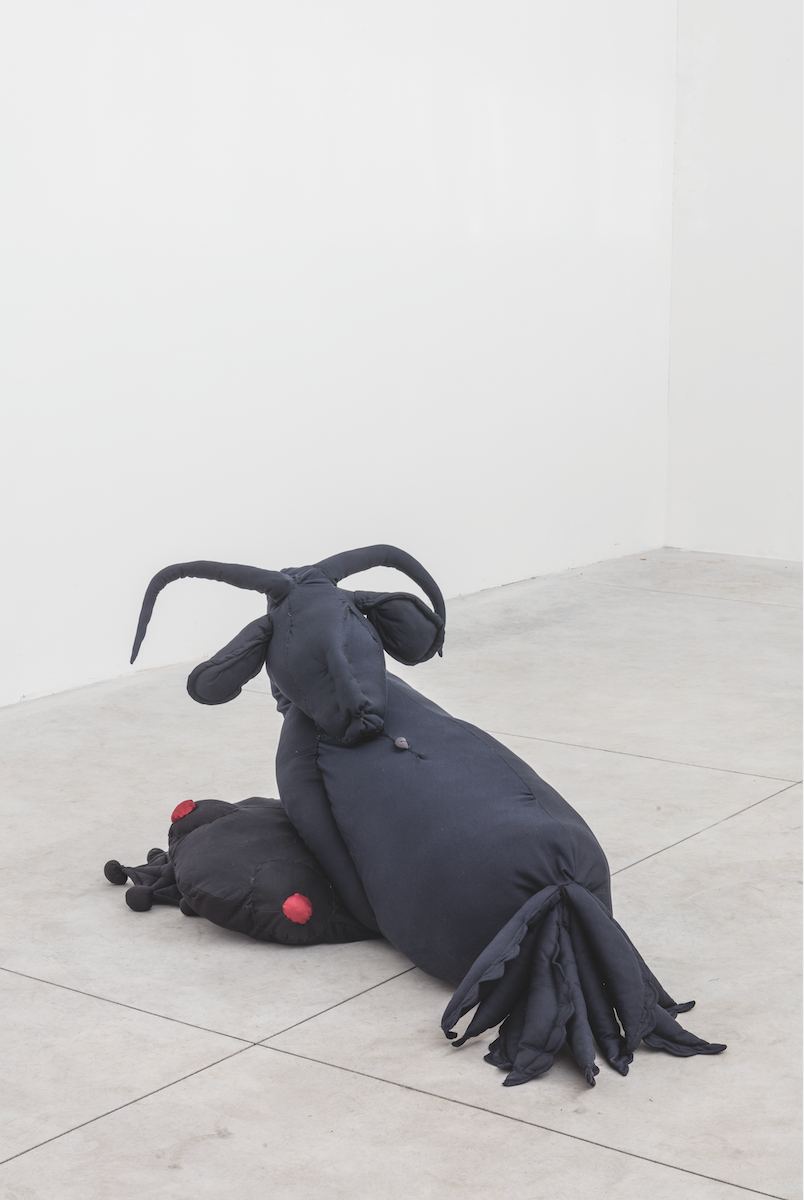

Per filo e per segno – 11/12. Claudia Losi
31.10.2026 – 01.12.2026
Claudia Losi
Discorso sulla prossimità
2016-2022
synthetic padding, metal wire
7 pieces
variable dimensions
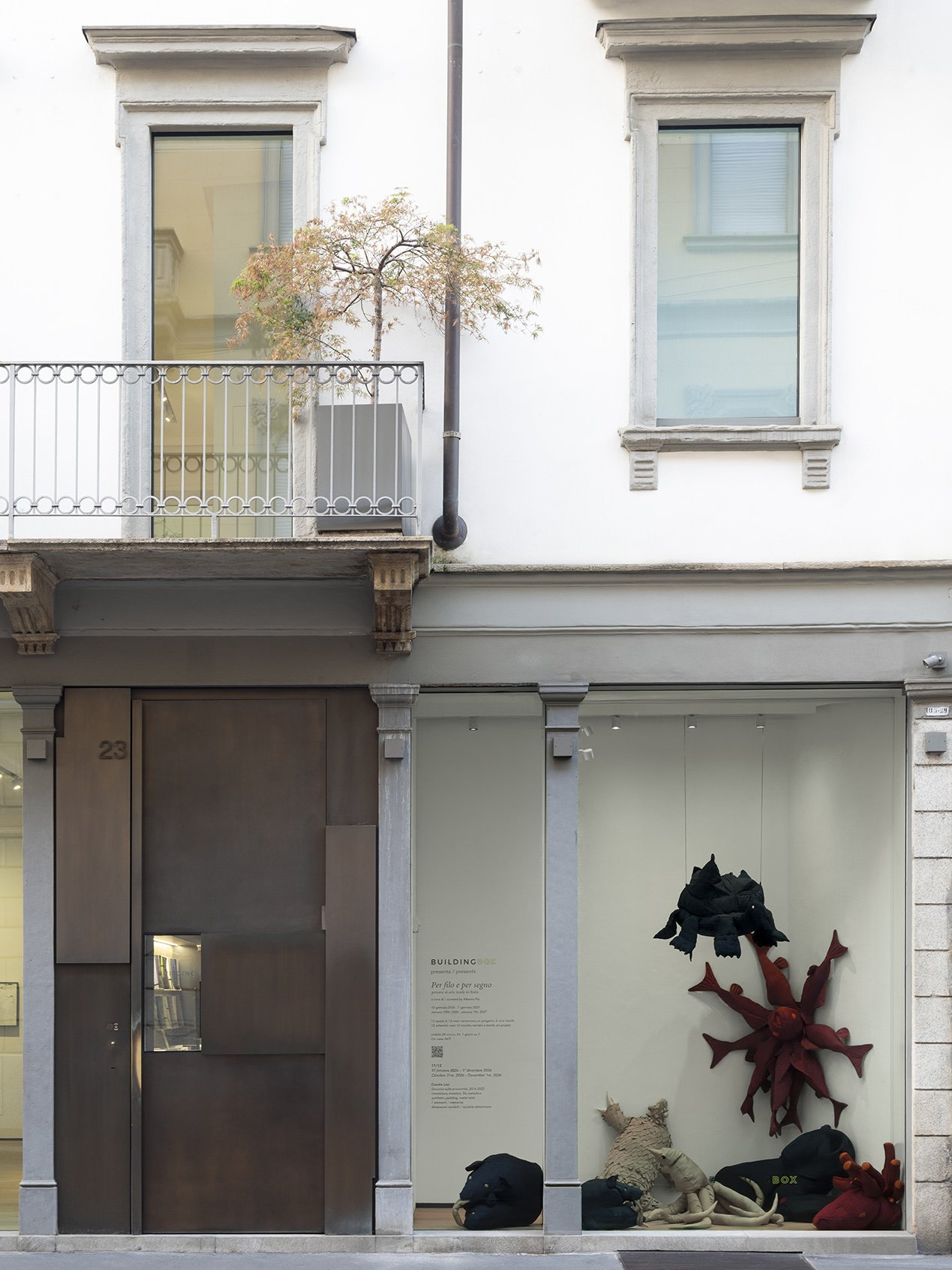
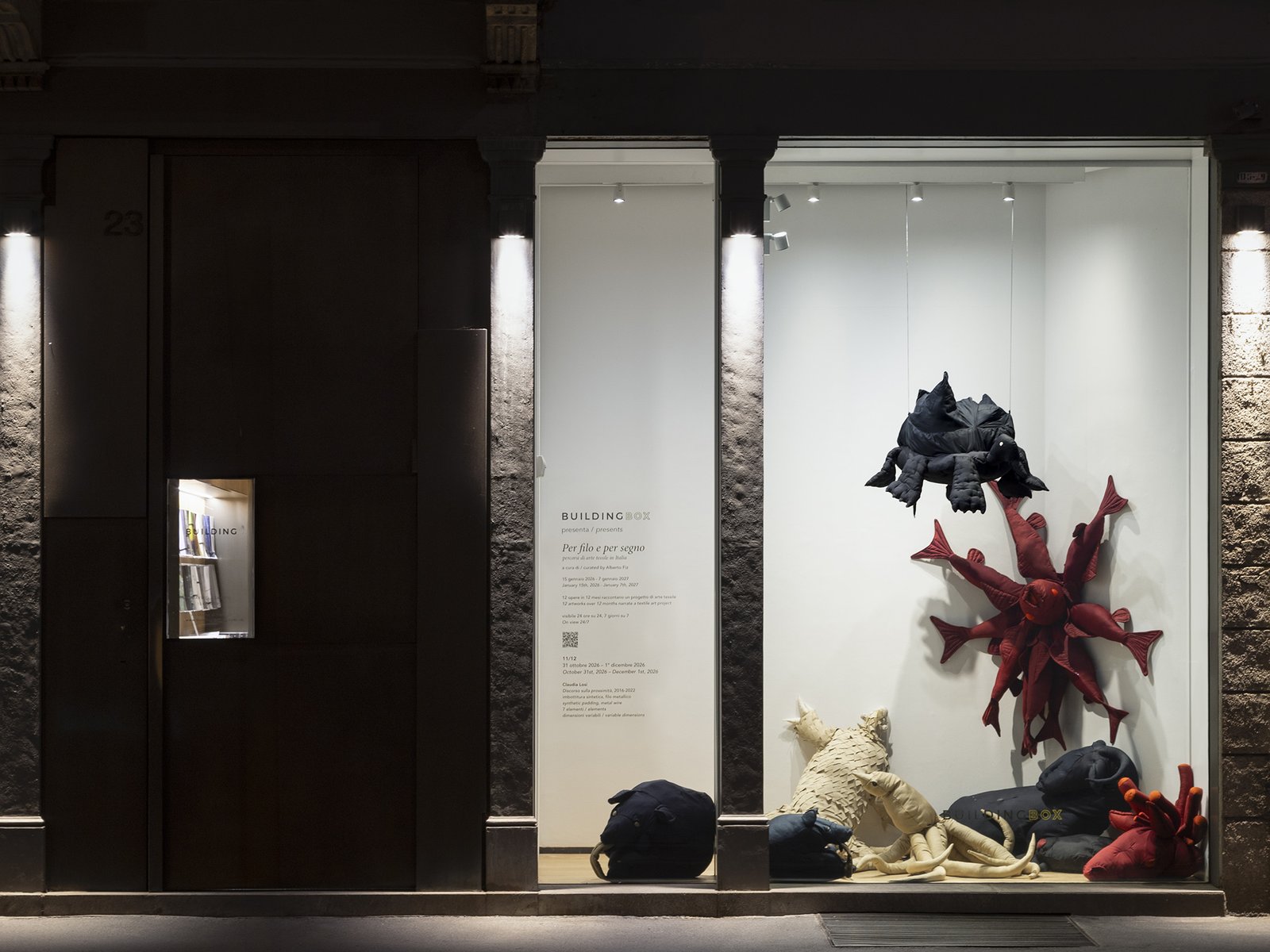
From October 31st to December 1st, 2026, BUILDING BOX presents the eleventh installation of the exhibition project Per filo e per segno. Percorsi di arte tessile in Italia with Discorso sulla prossimità (2016–2022) by Claudia Losi (Piacenza, 1971).
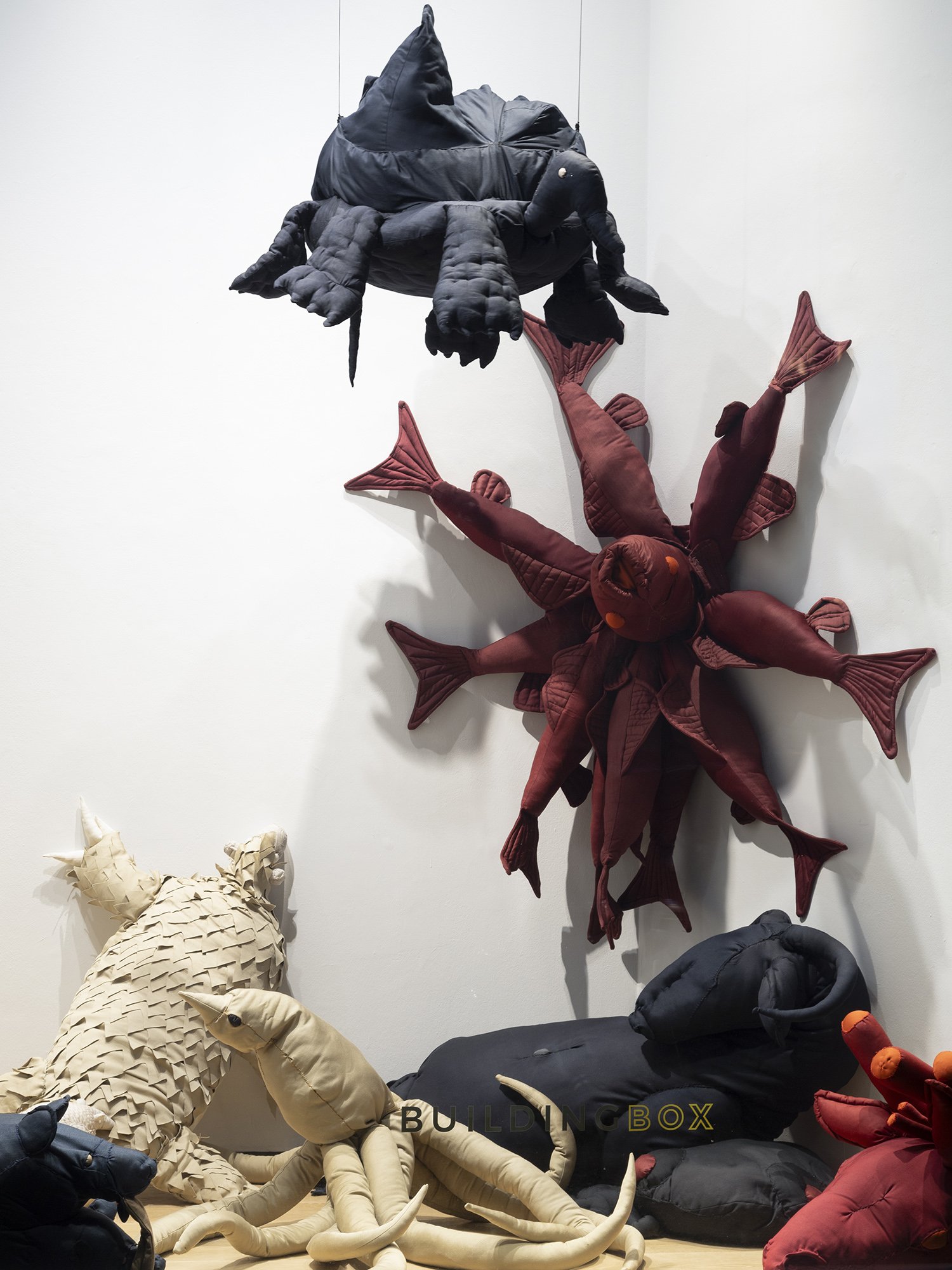
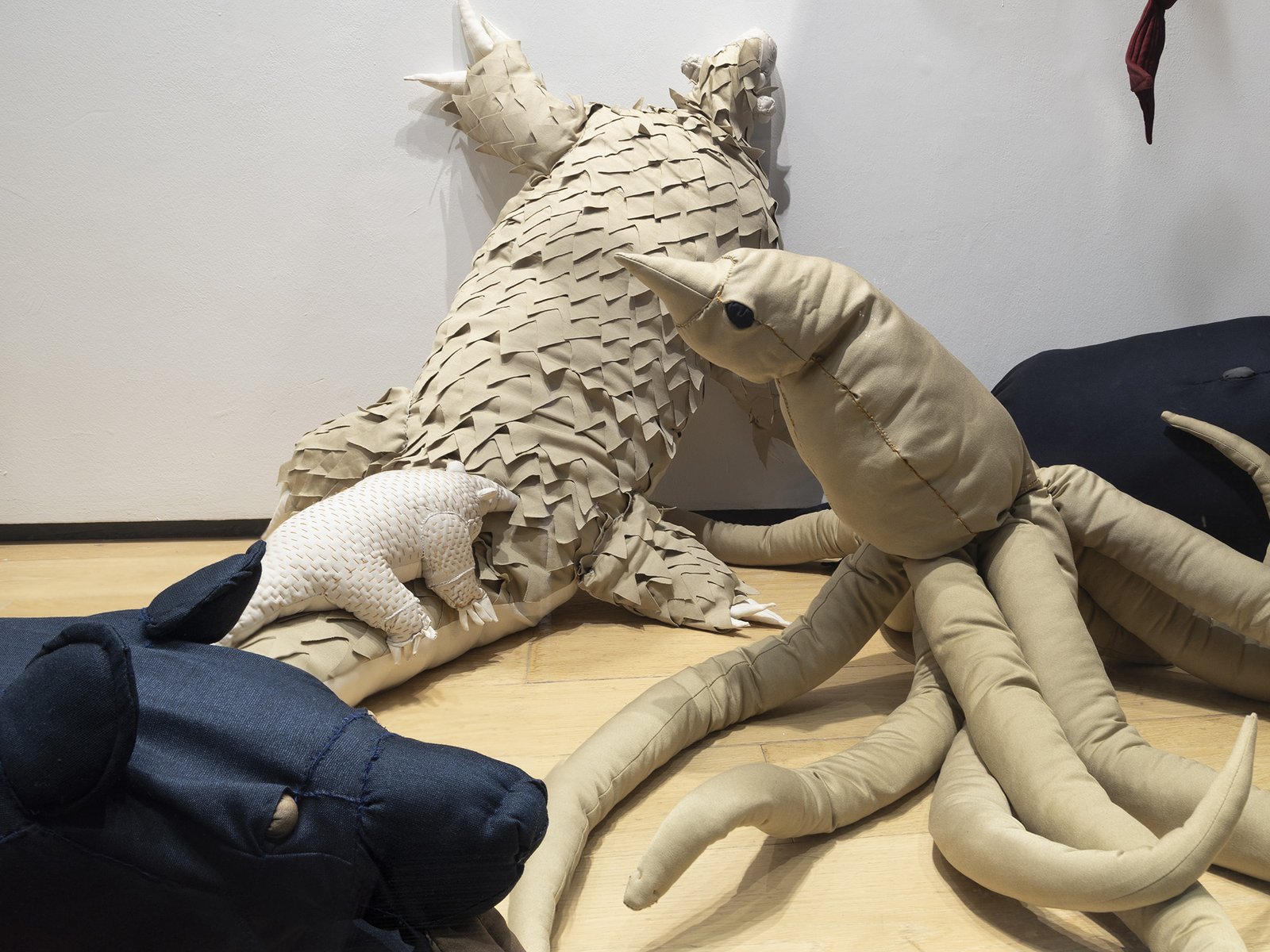
The installation, reworked specifically for BUILDING BOX, consists of a series of three-dimensional forms made of padded fabric and wire that give life to imaginary and fantastical creatures born from the hybridization of forms drawn from the animal and plant worlds. The artist constructs a visionary and metamorphic universe in which the very concept of identity is called into question.
At the heart of the work lies an interest in ancient bestiaries and, in particular, in A Chinese Bestiary: Strange Creatures from the Guideways Through Mountains and Seas, a Chinese text believed to have been written between the 4th and 1st centuries B.C. In the narrative, the geographical description of mountains, rivers, and territories—along with that of animals and plants—intertwines with the presence of fantastical creatures, giving rise to a system in which experiences of the world, myth, and imagination are not yet separated according to established canons of knowledge. Based on this, the artist constructs her own repertoire of possible organisms. However, the aim is not to illustrate the creatures described in ancient sources, but rather to adopt their combinatorial principle: elements belonging to different species are combined, modified, and recomposed according to a logic that alternates between plausibility and invention.
Openly fantastical forms thus coexist with others that might appear biologically plausible or with structures reminiscent of fossil morphology.
It is precisely this constant shifting—between what we recognize and what defies classification—that constitutes one of the central aspects of the work. Claudia Losi reimagines the boundaries through which we organize living things, replacing the separation between species with a logic based on contiguity and transformation.
Fabric becomes an integral part of this reflection. Its malleability allows volumes to be constructed without rigidly fixing them into a defined form: cutting, sewing, stuffing, and assembling are actions through which the material is progressively transformed into a body. The practice of working with fabric thus loses any ornamental character to take on a truly sculptural and constructive function. The thread makes that principle of relationship—which runs through the entire work—materially visible. The choice of textiles also implies a specific temporal dimension. Sewing means proceeding through a succession of gestures, through a slow process that accumulates traces and stages. It is a process that Claudia Losi implicitly contrasts with the immediacy of the image, reviving a practice in which the time taken to create the work remains inscribed in the material. The surface thus retains the memory of its construction, and the object becomes the result of a physical experience, even before it is a visual one. This focus on the act of making runs through the artist’s work and is accompanied by a constant interest in travel, the observation of the landscape, and encounters with different cultural systems.
The artwork thus becomes a space in which different ways of interpreting the world can coexist and give rise to new associations.
From this perspective, Discorso sulla prossimità takes on a broader meaning. Proximity does not merely indicate a closeness between different forms of life, but rather a mode of knowledge based on drawing near, observation, and relationship.
To know means to come into contact with that which is other than ourselves without necessarily reducing it to pre-established categories.
In the BUILDING BOX space, this reflection takes on particular significance. The figures are presented to the viewer as fragments of a narrative that has no predetermined order: it is the observer who establishes analogies and possible genealogies. The bestiary therefore does not offer a catalog of the fantastic, but rather an open framework capable of questioning the way we look at and relate different forms to one another. Thread becomes the tool through which this web of correspondences is woven.
The textile sculptures were created for the second edition of the Hangzhou Triennial of Fiber Art, Weaving & We, in Hangzhou, China, with the support of the Triennial itself.
___________
From January 15th 2026 to January 7th, 2027, BUILDING BOX presents Per filo e per segno. Percorsi di arte tessile in Italia, an exhibition project curated by Alberto Fiz involving twelve Italian artists from different generations, invited to reflect on the theme of contemporary textiles. Throughout 2026, the exhibition will offer a selection of tapestries, clothing, installations, sculptures and site-specific works in twelve individual monthly installations. The artists featured in the third quarter are Francesca Pasquali (Bologna, 1980), Franca Sonnino (Rome, 1932), Sissi (Bologna, 1977).
The last decade has been characterised by an increasing focus on textile art, which has established itself as one of the most vital languages of contemporary art. The reasons for this can be found, first and foremost, in its ability to restore a central role to the matter and the body in an era dominated by digital technology. Although the use of textiles is nothing new – just think of the fabrics of Fortunato Depero (1892-1960), the carpets of Giacomo Balla (1871-1958) or the tapestries of Alighiero Boetti (1940-1994) what has emerged is an unbiased, often provocative and transgressive process that has involved contemporary artists and, at the same time, has made it possible to highlight some central figures in art history, especially women, who have long been marginalised.
Furthermore, the uniqueness of textiles lies in how they have given rise to an autonomous language, with its own expressive matrix understood as a critical device capable of questioning all forms of hierarchy, according to a renewed awareness that can be traced back to the 2017 Venice Biennale, Viva Arte Viva, curated by Christine Macel, who had built her reflection starting precisely from textile art.
The exhibition project presented by BUILDING BOX aims to connect Italian artists from different generations by developing a fluid, all-encompassing journey that highlights the potential of a versatile, malleable and environmentally sustainable material, where tradition, memory and modernity intersect without rigid formalisation. At the same time, fibers, textures, knots and weaves become relational tools capable of redefining space and the relationship between individuals.
Per filo e per segno aims to make an innovative contribution to the debate on textile art, which on this occasion develops around different perspectives, offering a broader vision with the inclusion of a variety of works such as tapestries, clothing, installations, sculptures and site-specific works, many of which are new projects created specifically for this occasion, confirming how fabric is not only a technique but also an innovative approach to reality and image. Beyond the poetic and stylistic prerogatives, there is a unifying feature that can be traced throughout the exhibition, namely the intimate, in some ways autobiographical, aspect of the research, which is not without attention to the manual component, radically opposing the standardisation and dematerialisation of contemporary society. Per filo e per segno therefore aims to be a meticulous and detailed journey that contemplates the minimal unity of the textiles and the pattern that emerges when the threads are woven together. All this with the aim of generating a new plot through twelve chapters. The artists hosted during the first two quarters of the exhibition project were Numero Cromatico (an artistic collective founded in Rome in 2011), Paola Anziché (Milan, 1975), Maurizio Donzelli (Brescia, 1958), Antonio Marras (Alghero, 1961), Maria Lai (1919-2013), Paola Pezzi (Brescia, 1963), Francesca Pasquali (Bologna, 1980), Franca Sonnino (Rome, 1932), and Sissi (Bologna, 1977).