

Per filo e per segno – 8/12. Franca Sonnino
30.07.2026 – 31.08.2026
Franca Sonnino
Libreria
1997
iron, cotton thread
128 x 47 x 32,5 cm
Libro nero scritta bianca
2000
iron, cotton thread
50 x 40 cm
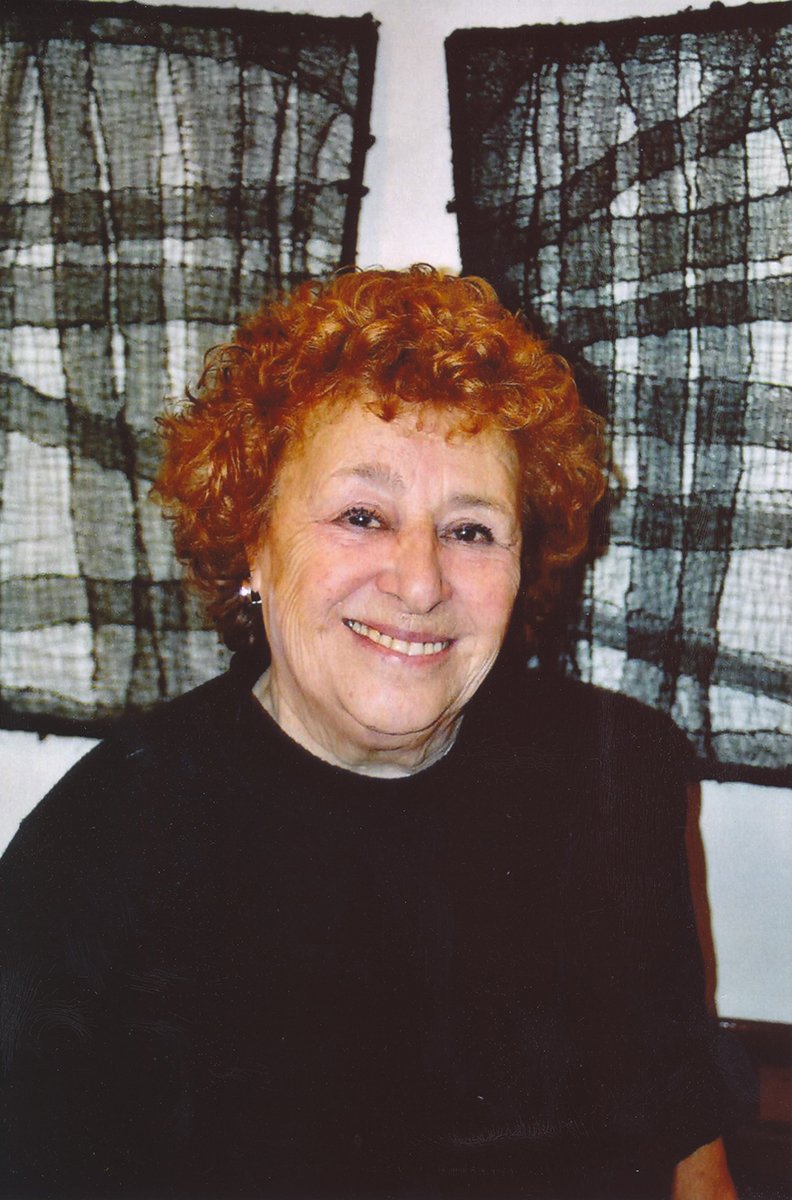
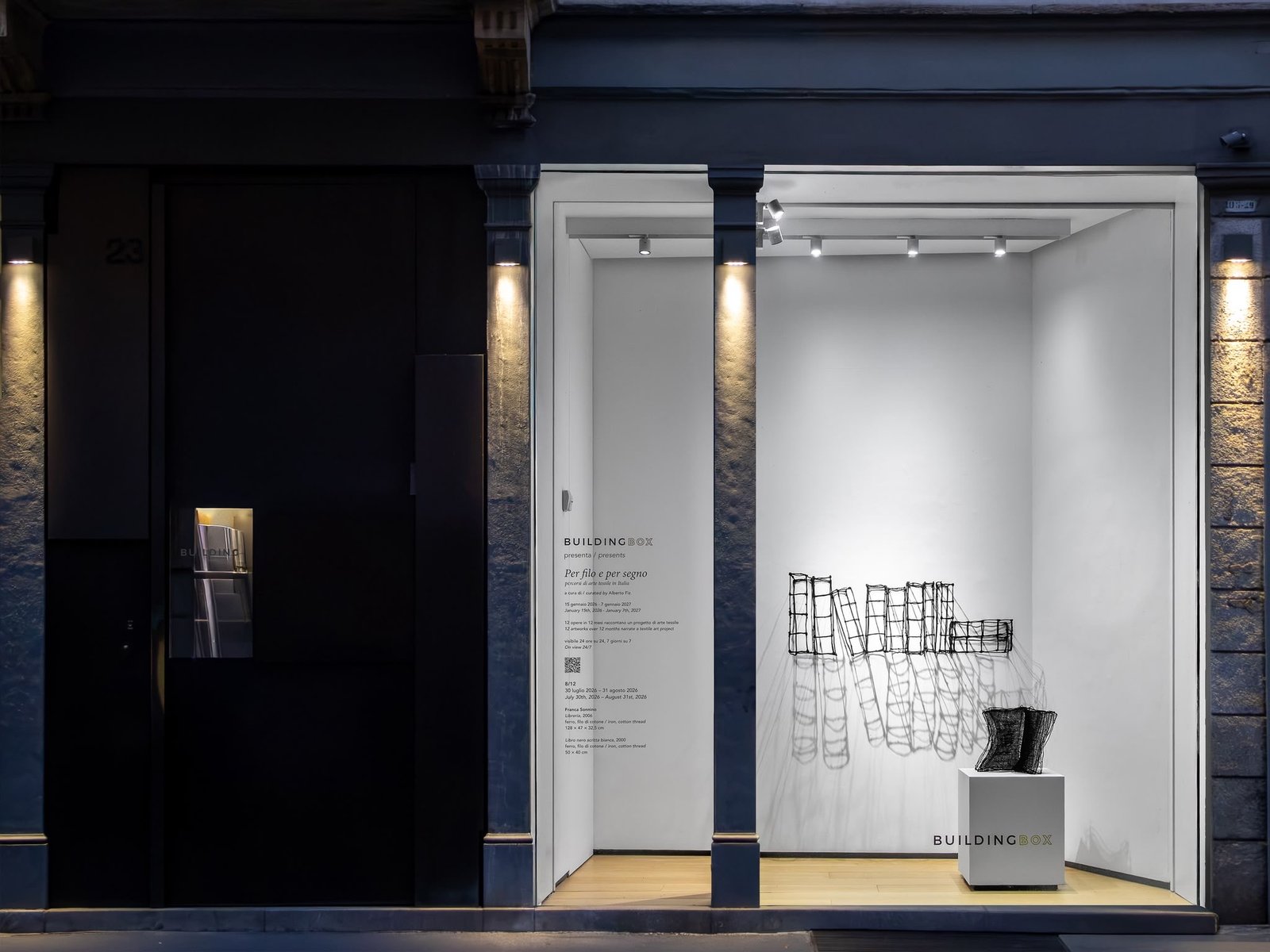
From July 30th to August 31st, 2026, BUILDING BOX presents the eighth appointment of the exhibition project Per filo e per segno. Percorsi di arte tessile in Italia, featuring the two works Libreria (1997) and Libro nero scritta bianca (2000) by Franca Sonnino (Rome, 1932).
These are two emblematic works, closely connected to one another, that synthesize the production of Franca Sonnino, one of the most significant figures in Italian textile art alongside Maria Lai, her main point of reference, with whom she shares a bond of friendship and artistic exchange.
The Librerie series was created in the late 1970s, when the artist abandoned painting to adopt thread as her preferred material.
The artwork presented in BUILDING BOX is created using cotton thread wrapped around an iron core to reproduce the outline of a bookshelf mounted on the wall. A series of books, devoid of volume and weight, are arranged on the shelves: silhouettes that suggest an immaterial dimension in which the container distances itself from its contents. The interior evokes the fragile and even impenetrable image of collective memory and its conditioning. As the artist states: “In bookshelves, which are already laden with hidden realities, I was fascinated by the seriality of the aligned books. The shadows that multiply the lines on the wall suggested to me the relationship—both symbolic and literal—with the cage.”
In what Enrico Crispolti has called an “orchestra of silence,” the bookshelf becomes a geometric grid that organizes the void, while the books, understood as rhythmic modules, become an image of knowledge rendered futile.
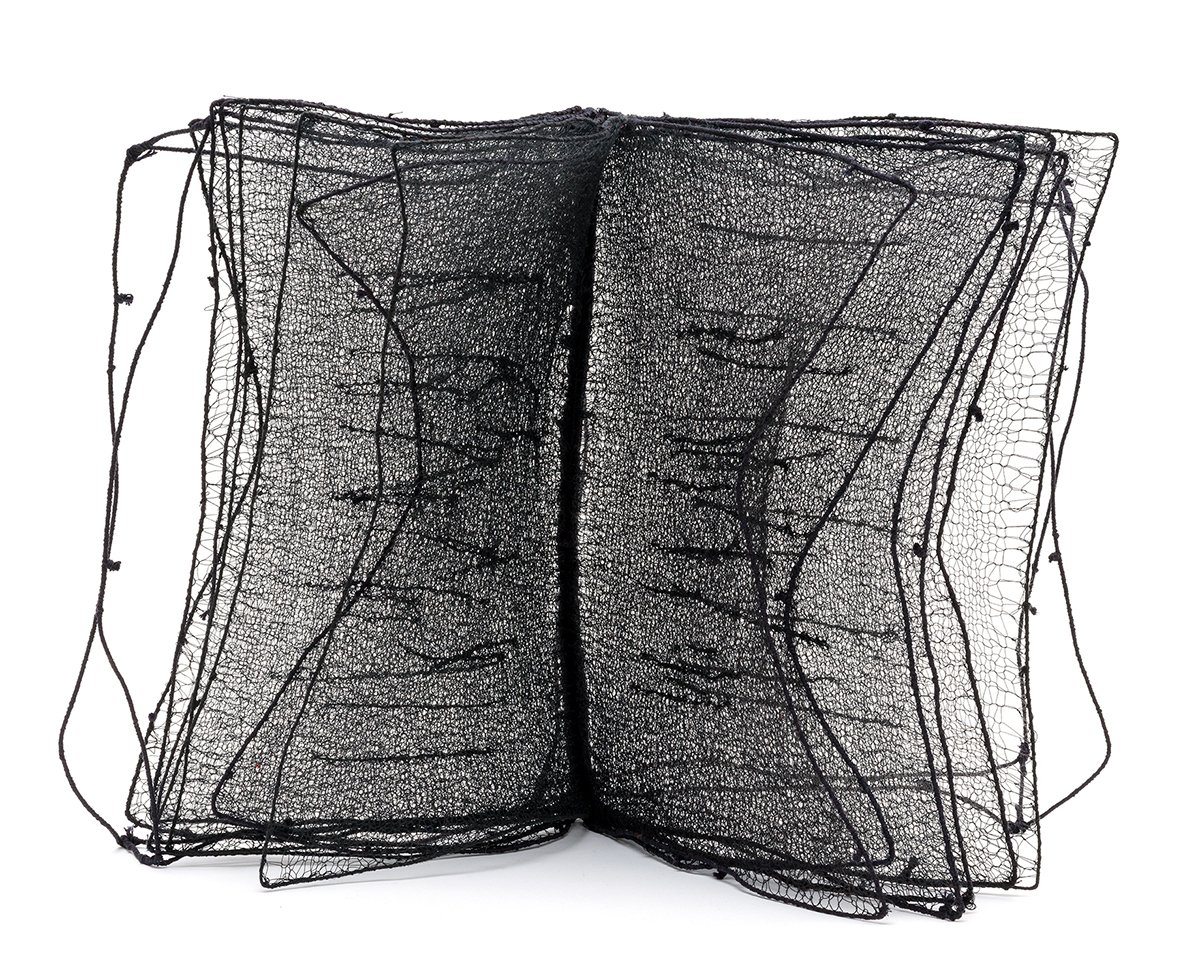
As a direct consequence of the Librerie, the Libri emerged in the 1980s, conceived as sculptural objects, also made of iron wire wrapped in wool or cotton. The pages are grids, membranes, and frameworks that reveal the very act of writing, the rhythm of the handwriting, and the deposition of the marks. While Maria Lai emphasizes the fairy-tale and narrative dimensions, Franca Sonnino’s work is characterized by a structural and spatial exploration in which the book becomes part of an architectural composition.
Libro nero scritta bianca, on display in the BUILDING BOX showcase, presents a reversal of elements: the title emphasizes the chromatic inversion compared to the traditional page, where black text appears on white paper. In this case, the black background becomes the page, and the white emerges as a luminous trace. It is evident how the metal wire “draws the air” and takes on a three-dimensionality capable of developing its own free and unpredictable movement. Franca Sonnino engages with absence through a dialogue with sculpture that could bring her closer to the work of Fausto Melotti. “I construct the void that things contain,” wrote the Roman artist, using an expression that would have been fully shared by the author of Contrappunti.
___________
From January 15th 2026 to January 7th, 2027, BUILDING BOX presents Per filo e per segno. Percorsi di arte tessile in Italia, an exhibition project curated by Alberto Fiz involving twelve Italian artists from different generations, invited to reflect on the theme of contemporary textiles. Throughout 2026, the exhibition will offer a selection of tapestries, clothing, installations, sculptures and site-specific works in twelve individual monthly installations. The artists featured in the third quarter are Francesca Pasquali (Bologna, 1980), Franca Sonnino (Rome, 1932), Sissi (Bologna, 1977).
The last decade has been characterised by an increasing focus on textile art, which has established itself as one of the most vital languages of contemporary art. The reasons for this can be found, first and foremost, in its ability to restore a central role to the matter and the body in an era dominated by digital technology. Although the use of textiles is nothing new – just think of the fabrics of Fortunato Depero (1892-1960), the carpets of Giacomo Balla (1871-1958) or the tapestries of Alighiero Boetti (1940-1994) what has emerged is an unbiased, often provocative and transgressive process that has involved contemporary artists and, at the same time, has made it possible to highlight some central figures in art history, especially women, who have long been marginalised.
Furthermore, the uniqueness of textiles lies in how they have given rise to an autonomous language, with its own expressive matrix understood as a critical device capable of questioning all forms of hierarchy, according to a renewed awareness that can be traced back to the 2017 Venice Biennale, Viva Arte Viva, curated by Christine Macel, who had built her reflection starting precisely from textile art.
The exhibition project presented by BUILDING BOX aims to connect Italian artists from different generations by developing a fluid, all-encompassing journey that highlights the potential of a versatile, malleable and environmentally sustainable material, where tradition, memory and modernity intersect without rigid formalisation. At the same time, fibers, textures, knots and weaves become relational tools capable of redefining space and the relationship between individuals.
Per filo e per segno aims to make an innovative contribution to the debate on textile art, which on this occasion develops around different perspectives, offering a broader vision with the inclusion of a variety of works such as tapestries, clothing, installations, sculptures and site-specific works, many of which are new projects created specifically for this occasion, confirming how fabric is not only a technique but also an innovative approach to reality and image. Beyond the poetic and stylistic prerogatives, there is a unifying feature that can be traced throughout the exhibition, namely the intimate, in some ways autobiographical, aspect of the research, which is not without attention to the manual component, radically opposing the standardisation and dematerialisation of contemporary society. Per filo e per segno therefore aims to be a meticulous and detailed journey that contemplates the minimal unity of the textiles and the pattern that emerges when the threads are woven together. All this with the aim of generating a new plot through twelve chapters. The artists hosted during the first two quarters of the exhibition project were Numero Cromatico (an artistic collective founded in Rome in 2011), Paola Anziché (Milan, 1975), and Maurizio Donzelli (Brescia, 1958), Antonio Marras (Alghero, 1961), Maria Lai (1919-2013), Paola Pezzi (Brescia, 1963).
Artisti