
Per filo e per segno – 9/12. Sissi
02.09.2026 – 30.09.2026
Sissi
Nidi
2026
rattan, fabric
variable dimensions
From September 2nd to 30th, 2026, BUILDING BOX presents the ninth appointment of the exhibition project Per filo e per segno. Percorsi di arte tessile in Italia with the installation Nidi (2026) by Sissi (Daniela Olivieri, Bologna, 1977).
The work, created specifically for BUILDING BOX, draws inspiration from a theme the artist has long explored, dating back to his 2004 exhibition at MACRO in Rome.
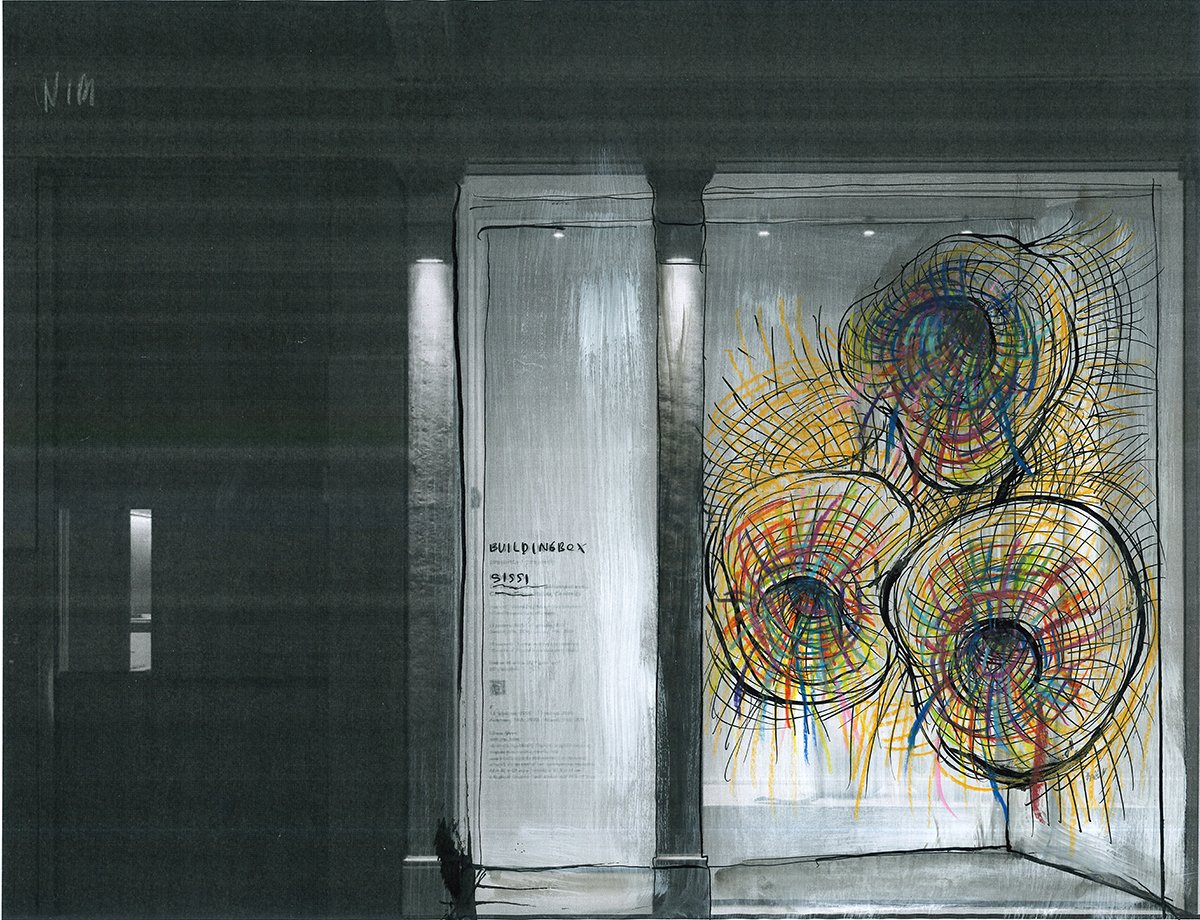
Nidi, made of woven and braided rattan, takes the form of an ever-evolving organism—an open shape that seems to develop according to the principles of biological growth. The structure gradually takes shape through the dialogue between the artist’s gesture and the inherent behavior of the materials, following a process in which control and unpredictability coexist. Thus, the work seems to follow the same logic of the development found in nature, where form is never a fixed entity, but the result of constant evolution. The rattan weave creates a light, porous texture that evokes the primitive architecture of a nest, the art of weaving, and the anatomical structure of the body; the fibers do not delimit a closed volume but generate a permeable membrane traversed by elements that expand into space. Numerous filaments protrude from the surface, taking on a life of their own, like branches or nerve endings that seem to extend the work’s growth beyond its boundaries, as part of an exploration that does not end within its own perimeter but suggests a potentially infinite proliferation.
Each element is defined first and foremost by its own void, and the deep central cavities subtract matter to transform it into presence, becoming the symbolic fulcrum of the entire composition. What might appear to be a tear or a wound is instead revealed as a generative space. From these openings emerges an unexpected explosion of color: reds, blues, yellows, greens, oranges, and purples form a sort of venous system that evokes the human body. According to this principle, sewing, embroidery, and weaving are not merely technical processes, but cognitive practices through which thought takes shape.
Nidi can therefore be interpreted as a reflection on the emergence of form and on the processual nature of inhabiting. The nest is not depicted as a finished object, but as a constructive device in a state of constant becoming. Architecture thus becomes a natural act even before it is a cultural one—a primal practice of building and caring that unites human beings with the animal world. “Just as birds shape their nests using their bodies as a measure and tool for verification, so I weave my structures, allowing the manual gesture to register proportions, tensions, and adaptations according to a deeply organic logic,” states Sissi, who, through this installation, explores some of the fundamental themes of her research: the body understood as an organism in transformation; the continuity between anatomy, nature, and the animal world; construction as a practice of knowledge; and weaving as a metaphor for relationships.
In short, the nest becomes the embodiment of a primordial space in which life takes shape.
___________
From January 15th 2026 to January 7th, 2027, BUILDING BOX presents Per filo e per segno. Percorsi di arte tessile in Italia, an exhibition project curated by Alberto Fiz involving twelve Italian artists from different generations, invited to reflect on the theme of contemporary textiles. Throughout 2026, the exhibition will offer a selection of tapestries, clothing, installations, sculptures and site-specific works in twelve individual monthly installations. The artists featured in the third quarter are Francesca Pasquali (Bologna, 1980), Franca Sonnino (Rome, 1932), Sissi (Bologna, 1977).
The last decade has been characterised by an increasing focus on textile art, which has established itself as one of the most vital languages of contemporary art. The reasons for this can be found, first and foremost, in its ability to restore a central role to the matter and the body in an era dominated by digital technology. Although the use of textiles is nothing new – just think of the fabrics of Fortunato Depero (1892-1960), the carpets of Giacomo Balla (1871-1958) or the tapestries of Alighiero Boetti (1940-1994) what has emerged is an unbiased, often provocative and transgressive process that has involved contemporary artists and, at the same time, has made it possible to highlight some central figures in art history, especially women, who have long been marginalised.
Furthermore, the uniqueness of textiles lies in how they have given rise to an autonomous language, with its own expressive matrix understood as a critical device capable of questioning all forms of hierarchy, according to a renewed awareness that can be traced back to the 2017 Venice Biennale, Viva Arte Viva, curated by Christine Macel, who had built her reflection starting precisely from textile art.
The exhibition project presented by BUILDING BOX aims to connect Italian artists from different generations by developing a fluid, all-encompassing journey that highlights the potential of a versatile, malleable and environmentally sustainable material, where tradition, memory and modernity intersect without rigid formalisation. At the same time, fibers, textures, knots and weaves become relational tools capable of redefining space and the relationship between individuals.
Per filo e per segno aims to make an innovative contribution to the debate on textile art, which on this occasion develops around different perspectives, offering a broader vision with the inclusion of a variety of works such as tapestries, clothing, installations, sculptures and site-specific works, many of which are new projects created specifically for this occasion, confirming how fabric is not only a technique but also an innovative approach to reality and image. Beyond the poetic and stylistic prerogatives, there is a unifying feature that can be traced throughout the exhibition, namely the intimate, in some ways autobiographical, aspect of the research, which is not without attention to the manual component, radically opposing the standardisation and dematerialisation of contemporary society. Per filo e per segno therefore aims to be a meticulous and detailed journey that contemplates the minimal unity of the textiles and the pattern that emerges when the threads are woven together. All this with the aim of generating a new plot through twelve chapters. The artists hosted during the first two quarters of the exhibition project were Numero Cromatico (an artistic collective founded in Rome in 2011), Paola Anziché (Milan, 1975), and Maurizio Donzelli (Brescia, 1958), Antonio Marras (Alghero, 1961), Maria Lai (1919-2013), Paola Pezzi (Brescia, 1963).
Artisti