Sergio Limonta
Sergio Limonta was born in Lecco in 1972 and graduated from the Brera Academy of Fine Arts with a thesis on the Chinese painter Hsiao Chin. He lives between Lecco and Milan.
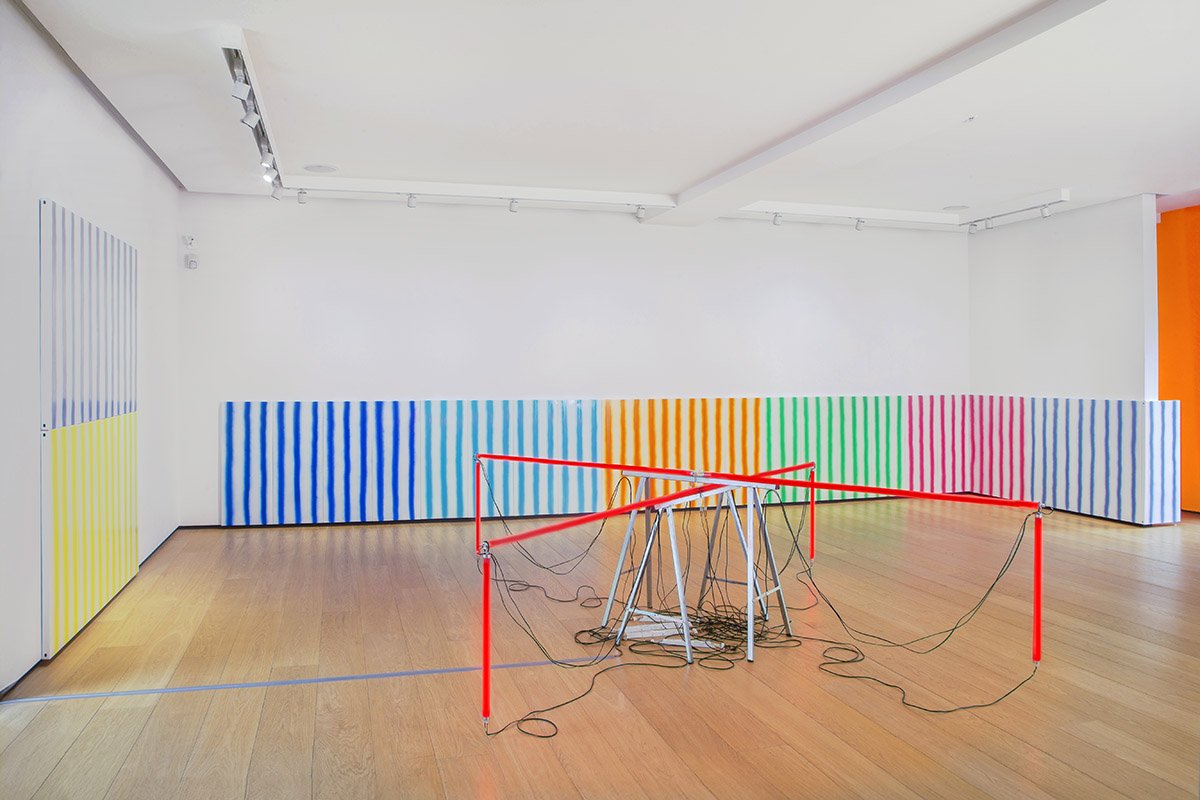
He focuses on a sculptural work based on found materials, however taken out of the traditional artistic canons, and often conceived and created in accordance with the exhibition space. His work reflects the etymon of a research always oriented towards experimentation, to the idea as the fulcrum around which the construction of the work is developed. He has focused his attention on the relationship between architecture and man, literature and the definition of meanings, and human behavior with respect to the environment. He made sound machines based on cacophonies, sound accidents and genre contaminations, reworked instances taken from art history. He has taken light as a primary element, employed in his sculptures and installations with a structural function, surpassing its lighting aspect.
He has exhibited in solo and group exhibitions in various public and private institutions and research spaces for Art including, among galleries: the AMT Gallery in Milan in 2008, Neon Gallery in Bologna in 2009, amt|project Gallery in Bratislava in 2014, Mazzoleni Gallery in Turin in 2018 and in London in 2019, BUILDING Gallery in Milan in 2022 and 2025. He has made projects for research spaces for Art including: the Fondazione Capri in Capri in 2012, Riss(e) in Varese in 2016, MARS in Milan in 2017, the Fondazione Zimei in Montesilvano in 2016 and 2019, The Open Box in Milan in 2020, the Archivio Vincenzo Agnetti in Milan in 2022, the Casa degli Artisti also in Milan in 2023. In 2020, he created three large sculptures for the cloister garden of the Museo Novecento in Florence with the exhibition Il massimo col minimo as part of the Grafts project. Among the museums we remind: the Municipal Gallery in Monfalcone, and the Macro Museum in Rome in 2004, the Milan Triennale in 2009, the MAGA Museum in Gallarate in 2011, 2013 and 2016, and the MAMBO Museum in Bologna in 2016.
Mostre