Per filo e per segno – 3/12. Maurizio Donzelli
13.03.2026 – 08.04.2026
Maurizio Donzelli
Giardini Del Quasi
2025
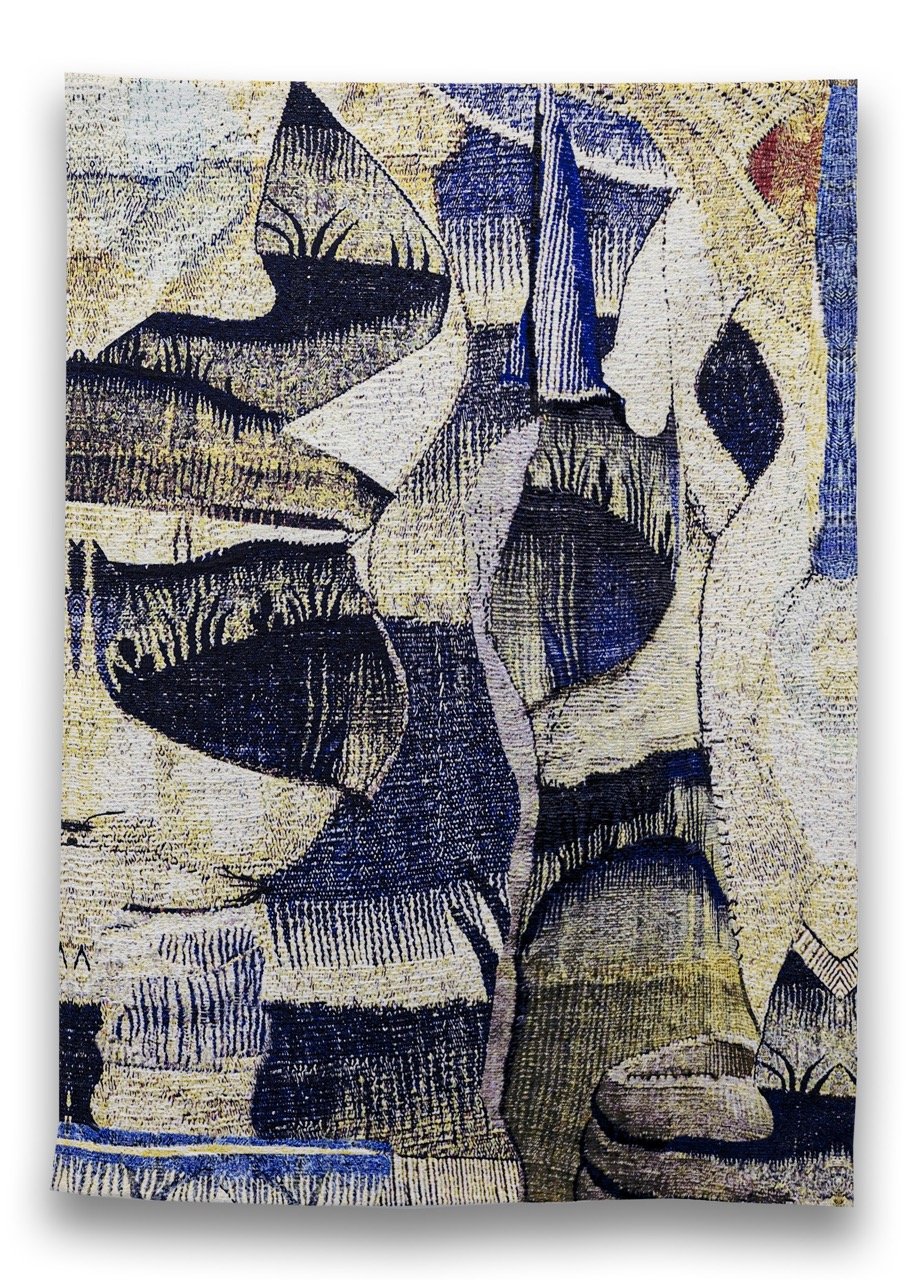
tapestry, wool, cotton, woven on a Jacquard loom in Flanders
two panels: 185 x 135 cm, 180 x 135 cm
From March 13th to April 8th, 2026, BUILDING BOX presents the third installation of the exhibition project Per filo e per segno. Percorsi di arte tessile in Italia with Giardini Del Quasi (2025) by Maurizio Donzelli (Brescia, 1958).
The installation presented by BUILDING BOX was created for this occasion by vertically combining two tapestries from 2022, giving rise to a new artwork that questions the perceptual component, creating a condition of suspension and doubt based on the founding principles of all his work.
As he himself states, “the perceptible is always enormously greater, enormously richer than what we see, and above all, the objects we observe return our gaze”.
The two tapestries, made on a jacquard loom, refer to Bramantino’s Cycle of the Months (1456- 1530), preserved at the Castello Sforzesco in Milan and reinterpreted by Donzelli in an anti- narrative key. This interpretation is accentuated by the superimposition and manipulation of the original data, intended to generate unpredictable interference, leading to a latent and deeply problematic vision with signs that undergo progressive mutation. It is the very concept of perception that is called into question in a reinterpretation that gives rise to iridescent and palindromic forms according to a mirrored and reversible structure, characterized by analogies and possible resonances.
The artist removes the figures and focuses on fairy-tale-like, dreamlike vegetation that draws the viewer in, attracted by an intangible place where tapestry appears to be the most suitable medium for creating tension between time, perception and image. Based on this logic, Donzelli embraces the concept favoured by Paul Klee (1879-1940) that “Art does not repeat visible things, but makes them visible”.
Beyond any mimicry, the image determines itself without imposing its will, creating an introspective dialogue with the observer. All this is evident in Donzelli’s entire production, from Mirrors (begun in 2002), mirroring and distorting devices, to Nets (the first dating back to 2023), nets that expand and contract as if they were breathing. The work on display in BUILDING BOX’s windows is a further digression on the enigma of vision, or rather the imenigma [an anagram of the Italian word for image, (immagine)], as Donzelli defines it.
Between resonances, analogies and distant echoes, the shapes in the tapestry hint at somewhere else, creating a sense of distance. This is why the artwork titled Giardini Del Quasi, which refers to a concept rather than a specific place. The artist has often used this expression, as in the series Disegno del Quasi or Etcetera Drawing, which he has been producing since the late 1990s, stating what is by its nature an experience of knowledge outside predefined boundaries: “I could call all my works Quasi (Almost) because it is a category of the soul and not a real title,” he reiterates.
___________
From January 15th 2026 to January 7th, 2027, BUILDING BOX presents Per filo e per segno. Percorsi di arte tessile in Italia, an exhibition project curated by Alberto Fiz involving twelve Italian artists from different generations, invited to reflect on the theme of contemporary textiles.
Throughout 2026, the exhibition will offer a selection of tapestries, clothing, installations, sculptures and site-specific works in twelve individual monthly installations. The first three artists presented are: Numero Cromatico (artistic collective founded in Rome, 2011), Paola Anziché (Milan, 1975) and Maurizio Donzelli (Brescia, 1958).
The last decade has been characterised by an increasing focus on textile art, which has established itself as one of the most vital languages of contemporary art. The reasons for this can be found, first and foremost, in its ability to restore a central role to the matter and the body in an era dominated by digital technology. Although the use of textiles is nothing new – just think of the fabrics of Fortunato Depero (1892-1960), the carpets of Giacomo Balla (1871-1958) or the tapestries of Alighiero Boetti (1940-1994) what has emerged is an unbiased, often provocative and transgressive process that has involved contemporary artists and, at the same time, has made it possible to highlight some central figures in art history, especially women, who have long been marginalised.
Furthermore, the uniqueness of textiles lies in how they have given rise to an autonomous language, with its own expressive matrix understood as a critical device capable of questioning all forms of hierarchy, according to a renewed awareness that can be traced back to the 2017 Venice Biennale, Viva Arte Viva, curated by Christine Macel, who had built her reflection starting precisely from textile art.
The exhibition project presented by BUILDING BOX aims to connect Italian artists from different generations by developing a fluid, all-encompassing journey that highlights the potential of a versatile, malleable and environmentally sustainable material, where tradition, memory and modernity intersect without rigid formalisation. At the same time, fibers, textures, knots and weaves become relational tools capable of redefining space and the relationship between individuals.
Per filo e per segno aims to make an innovative contribution to the debate on textile art, which on this occasion develops around different perspectives, offering a broader vision with the inclusion of a variety of works such as tapestries, clothing, installations, sculptures and site- specific works, many of which are new projects created specifically for this occasion, confirming how fabric is not only a technique but also an innovative approach to reality and image. Beyond the poetic and stylistic prerogatives, there is a unifying feature that can be traced throughout the exhibition, namely the intimate, in some ways autobiographical, aspect of the research, which is not without attention to the manual component, radically opposing the standardisation and dematerialisation of contemporary society. Per filo e per segno therefore aims to be a meticulous and detailed journey that contemplates the minimal unity of the textiles and the pattern that emerges when the threads are woven together. All this with the aim of generating a new plot through twelve chapters.
Artisti